Meal prep doesn’t always need to mean cooking five identical containers of chicken, rice, and vegetables.
Sometimes the most useful meal prep is simply having a few different combinations ready to grab from the refrigerator. A clear glass container makes that especially easy because you can see exactly what you’ve prepared before opening the fridge.
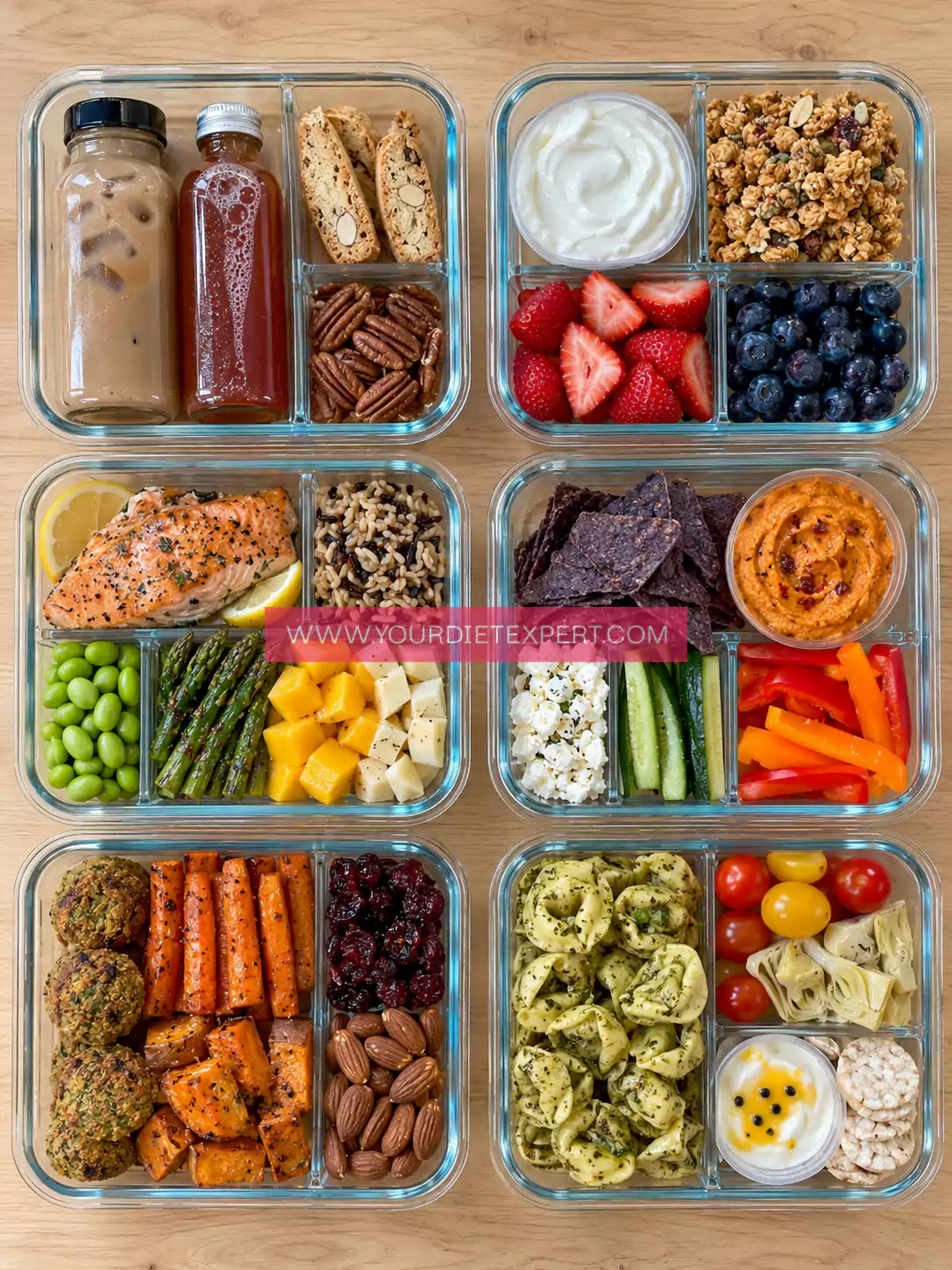
These 6 glass meal prep tray ideas take that approach in six completely different directions. There is a breakfast-style yogurt and berry box, a Mediterranean-inspired dip tray, a salmon and wild rice combination, a falafel and roasted vegetable tray, a pesto tortellini box, and even a cold-brew-and-snack combination for mornings or lighter breaks.
The original meal-prep grid also demonstrates something important: not every container needs to follow exactly the same formula.
One tray can be protein-forward, another can focus on vegetables and dips, while another can function more like a snack box.
The trick is to build each container around foods that complement one another in texture, flavor, convenience, and storage.
Pesto Tortellini Box
Pasta + tomatoes + artichokes
Why Glass Meal Prep Trays Work So Well
Clear glass containers have a practical advantage beyond appearance: you can see the food before you open the refrigerator.
That small detail can make prepared food easier to use consistently. Instead of wondering what is inside a container, you can immediately see whether you’re reaching for salmon and vegetables, yogurt and berries, or a Mediterranean snack tray.
Glass is also useful for foods that may be reheated, although you should always follow the manufacturer’s instructions regarding oven, microwave, freezer, and temperature-shock use.
For these particular meal-prep ideas, another advantage is the ability to create visual separation between components.
Hummus can sit beside vegetables. Granola can remain away from yogurt. Fresh fruit can stay separate from savory foods. Dips can be placed in small compartments or leak-resistant containers.
That separation helps preserve texture.
The key is not simply buying a glass container and filling every section randomly. Think about what needs to stay crisp, creamy, dry, cool, or separate.
1. Cold Brew & Snack Box
The first tray is more of a grab-and-go breakfast or snack box than a traditional lunch.
It combines oat milk cold brew, kombucha, biscotti or shortbread-style cookies, and whole pecans.
It’s particularly useful for mornings when you want to prepare your drinks and a small snack in advance instead of reaching for whatever happens to be available.
What Goes Into the Box
Oat milk cold brew
Kombucha
1–2 small biscotti or shortbread-style cookies
Whole pecans
The original tray shows the drinks taking up much of the container while the baked snack and pecans occupy the remaining space.
For practical meal prep, I would keep the beverages in their own sealed containers or bottles rather than pouring them directly into the glass food container.
How to Prepare It
Prepare cold brew and add your preferred amount of oat milk.
Transfer it into a leak-resistant bottle.
Chill the kombucha separately.
Portion a small amount of biscotti or shortbread.
Add a modest handful of pecans.
Store everything refrigerated as appropriate for the perishable ingredients.
A Better Everyday Variation
If you want this box to function more like a balanced breakfast rather than simply a snack tray, consider adding a protein-rich component such as plain Greek yogurt or another suitable protein food.
You can also replace the cookies with:
Whole-grain crackers
Fresh fruit
Oat-based energy bites
A small serving of granola
Whole-grain toast pieces
Watch the Added Sugar
Cold beverages, kombucha, cookies, and flavored snack products can all contribute different amounts of added sugar.
If you’re trying to keep the meal more balanced, compare nutrition labels and choose unsweetened or lower-sugar versions where appropriate.
Morning Box
Build It in 4 Simple Parts
☕
DRINK
Cold brew
🥤
OPTIONAL
Kombucha
🍪
TREAT
Small portion
🥜
CRUNCH
Pecans or nuts
2. Yogurt Berry Bowl With Granola
This is one of the simplest combinations in the collection, but it’s also one of the easiest to customize.
The tray combines thick Greek yogurt with granola, strawberries, and blueberries.
You get creamy yogurt, crunchy granola, juicy berries, and natural sweetness in a combination that works for breakfast, a snack, or a lighter meal depending on portion size.
Ingredients
¾–1 cup plain Greek yogurt
¼–⅓ cup granola
½ cup strawberries
½ cup blueberries
How to Assemble
Add Greek yogurt to a clean container.
Wash and thoroughly dry the berries.
Slice strawberries if desired.
Add strawberries and blueberries.
Keep granola separate until eating.
That final step makes a surprisingly big difference.
If granola sits directly in yogurt overnight, it loses its crunch. A separate compartment or small sealed container keeps the textures much better.
Easy Variations
Instead of strawberries and blueberries, try:
Raspberries
Blackberries
Sliced peaches
Apple
Pear
Kiwi
Chopped mango
For additional texture, add chia seeds, pumpkin seeds, walnuts, or almonds if they fit your dietary needs.
For a higher-protein option, choose a Greek yogurt or strained yogurt with a protein content that fits your goals.
What About the 5% Yogurt Shown?
A full-fat Greek yogurt can be rich and satisfying, but it is also more calorie-dense than lower-fat versions.
Neither option is inherently better for everyone. Choose based on your preferences and overall dietary needs.
3. Lemon-Seared Salmon & Asparagus Bowl
This is the most substantial savory meal in the collection.
The original tray combines lemon-seared salmon with wild rice, edamame, roasted asparagus, mango, and cheese.
It works because the flavors and textures move in different directions: savory salmon, nutty rice, green vegetables, sweet mango, creamy edamame, and a small amount of cheese.
Prep Time
15 minutes
Cook Time
20–25 minutes
Total Time
35–40 minutes
Servings
1–2 meal-prep portions
Ingredients
4–5 ounces salmon fillet
¾ cup cooked wild rice or wild rice blend
½ cup shelled edamame
½–1 cup asparagus
½ cup cubed mango
Small serving cheese
Lemon
1–2 teaspoons cooking oil
Salt and pepper
Instructions
Pat the salmon dry.
Season with salt, pepper, and fresh lemon.
Heat a skillet with a small amount of oil.
Cook the salmon until it reaches a safe internal temperature and flakes easily.
Roast or steam the asparagus until tender but still firm.
Cook the wild rice according to package directions.
Prepare the edamame.
Allow cooked ingredients to cool appropriately before packing.
Place rice in the main section.
Add salmon, asparagus, edamame, mango, and cheese to separate areas.
Why Mango Works Here
Mango provides a sweet contrast to the savory salmon and earthy rice.
If you don’t have mango, pineapple, orange segments, or apple can create a different but equally useful contrast.
Protein Note
Salmon and edamame both contribute protein, while salmon also provides omega-3 fatty acids.
The exact nutrition of the box will depend heavily on salmon quantity, rice portion, edamame, cheese, and cooking oil.
Salmon Bowl Formula
Savory + Green + Sweet
🐟
SALMON
main protein
+
🌾
WILD RICE
hearty base
+
🥦
GREENS
asparagus + edamame
+
🥭
SWEET
mango contrast
4. Mediterranean Dip Tray
This container is built more like a grazing box.
Roasted red pepper hummus is paired with blue corn tortilla chips, feta cheese, cucumber sticks, and colorful bell peppers.
It’s a particularly useful template for days when you don’t want a conventional cooked lunch.
Ingredients
⅓–½ cup roasted red pepper hummus
Small serving blue corn tortilla chips
1–2 ounces feta cheese
½ cucumber
½–1 bell pepper
Optional fresh herbs
Instructions
Spoon hummus into a small leak-resistant compartment or container.
Cut cucumber into sticks.
Slice bell pepper into strips.
Crumble or cube the feta.
Portion tortilla chips separately.
Keep the chips away from hummus and cut vegetables until eating.
Make It More Substantial
If this tray is intended to replace lunch rather than serve as a snack, add a more substantial protein source.
Good options include:
Grilled chicken
Hard-boiled eggs
Chickpeas
Baked tofu
Edamame
Turkey slices
You can also add a whole-grain pita or whole-grain crackers instead of relying entirely on tortilla chips.
The Hummus Advantage
Hummus brings chickpeas and tahini into the tray, contributing plant protein, fiber, and unsaturated fats.
The exact nutrition varies considerably between homemade and commercial hummus.
5. Baked Falafel & Roasted Vegetable Tray
This is a hearty plant-forward option built around baked falafel, roasted carrots, sweet potato slices, dried cranberries, and almonds.
It has a particularly nice mix of textures: crisp-edged falafel, soft roasted vegetables, chewy dried fruit, and crunchy almonds.
Ingredients
3–4 baked falafel
½ cup roasted carrots
½ cup roasted sweet potato
1–2 tablespoons dried cranberries
2 tablespoons almonds
Instructions
Prepare or bake the falafel until cooked through and lightly browned.
Cut carrots into similar-sized pieces.
Slice sweet potato into rounds or wedges.
Roast the vegetables until tender and lightly caramelized.
Allow everything to cool before assembling.
Add falafel to the largest compartment.
Arrange carrots and sweet potato beside it.
Finish with a small serving of dried cranberries and almonds.
A Useful Meal-Prep Adjustment
Dried cranberries can contain quite a bit of added sugar depending on the product.
If you’d prefer a less sweet tray, substitute:
Fresh berries
Apple slices
Orange segments
Unsweetened dried fruit
Increasing the Protein
Falafel contains plant protein, but the total amount can vary significantly by recipe and portion.
If you want a more protein-forward meal, add a side of hummus, Greek yogurt-based sauce, edamame, lentils, or another suitable protein source.
Texture Map
Why This Tray Feels Satisfying
🧆
SAVORY
Falafel
🍠
SOFT
Roasted veg
🍒
CHEWY
Dried fruit
🌰
CRUNCHY
Almonds
6. Pesto Tortellini & Artichoke Box
The final tray is the most pasta-focused combination in this collection.
Pesto tortellini is paired with cherry tomatoes, marinated artichoke hearts, a passion-fruit yogurt, and mini rice cakes.
It’s a good example of how a meal-prep container can combine a familiar comfort-food component with fresh produce and smaller sides.
Ingredients
1 cup cooked tortellini
1–2 tablespoons pesto
½ cup cherry tomatoes
¼–½ cup marinated artichoke hearts
Small serving yogurt
Mini rice cakes
Instructions
Cook the tortellini according to package instructions.
Drain and allow it to cool slightly.
Toss with pesto while the pasta is still slightly warm.
Allow it to cool appropriately before packing.
Add cherry tomatoes and artichoke hearts.
Pack yogurt separately.
Add rice cakes to a dry compartment.
Keep the Rice Cakes Crunchy
Rice cakes absorb moisture quickly.
Keep them away from tomatoes, artichokes, yogurt, and pesto.
If your container does not have enough separation, pack them in a small separate bag or container.
Make It More Balanced
Tortellini already provides carbohydrates and some protein depending on the filling.
For a more substantial lunch, add grilled chicken, white beans, chickpeas, edamame, or another protein source.
You can also increase the vegetables by adding roasted zucchini, spinach, bell peppers, or broccoli.
How to Meal Prep These Glass Trays Efficiently
You don’t need to make all six trays from scratch on the same day.
A better approach is to identify shared preparation tasks.
For example, one cooking session can produce:
Roasted sweet potatoes
Roasted carrots
Cooked wild rice
Cooked salmon
Baked falafel
Washed vegetables
Cut fruit
Then assembly becomes much faster.
Prep Workflow
One Prep Session, Several Components
1
COOK
Rice, salmon, falafel, vegetables
2
WASH
Berries, tomatoes, cucumber, peppers
3
PORTION
Nuts, dips, fruit, crunchy sides
4
ASSEMBLE
Keep wet and dry foods apart
A Simple Prep-Day Strategy
Step 1: Cook the Longest Items First
Start with foods that require the most time, such as:
Wild rice
Sweet potatoes
Roasted carrots
Falafel
Salmon
While those are cooking, move on to the cold components.
Step 2: Wash and Dry Produce
Wash berries, tomatoes, cucumber, peppers, and other fresh produce.
Drying them thoroughly is important.
Extra surface moisture can make prepared foods deteriorate faster and can make crunchy foods unpleasantly soggy.
Step 3: Portion the Dry Components
Measure out:
Almonds
Pecans
Granola
Rice cakes
Tortilla chips
Dried cranberries
Keeping these ingredients separate from moist foods preserves their texture.
Step 4: Prepare Dips and Sauces
Hummus, pesto, dressings, and other sauces should be portioned into leak-resistant containers or separate compartments.
Step 5: Assemble the Trays
Once cooked ingredients have cooled appropriately, build the containers.
Don’t overcrowd them.
Leaving a little space between foods makes it easier to remove one component without disturbing everything else.
How to Keep Glass Meal Prep Containers Fresh
One of the biggest advantages of these trays is the compartment-style organization, but good storage still matters.
Keep Wet Foods Away From Dry Foods
This is especially important for:
Yogurt and granola
Hummus and tortilla chips
Pesto and rice cakes
Fresh fruit and crackers
Tomatoes and crunchy snacks
Cool Cooked Foods Before Sealing
Cooked salmon, rice, sweet potatoes, carrots, falafel, and tortellini should be handled appropriately and cooled before being sealed and refrigerated.
Keep Refrigerated Foods Cold
Perishable foods should be refrigerated promptly and kept cold during storage.
If you are taking the food to work or school without access to a refrigerator, use an insulated lunch bag and an appropriate cold pack.
Prepare Delicate Components Later
Some foods simply don’t maintain their best texture for as long as others.
Fresh berries, crisp vegetables, crunchy snacks, and cut fruit may need different preparation timing than cooked grains or roasted vegetables.
Freshness Timeline
Prep the Right Foods at the Right Time
EARLIER
🍠
COOKED FOODS
Rice, sweet potato, carrots, falafel
PREP DAY
🥒
FRESH PRODUCE
Wash, dry, portion and cut
CLOSER TO EATING
🥣
CRUNCH + DELICATE ITEMS
Granola, chips, rice cakes, fresh fruit
Nutrition: How to Turn These Trays Into Full Meals
Not every tray shown here has the same nutritional purpose.
The cold-brew box is primarily a snack-style combination.
The yogurt box can function as breakfast or a snack depending on portion size.
The salmon tray is naturally more substantial because it contains fish, rice, edamame, vegetables, fruit, and cheese.
The Mediterranean box can range from a light snack to a meal depending on how much hummus, feta, chips, and protein you include.
The falafel tray is plant-forward and can become more protein-rich with additional hummus, beans, tofu, lentils, or yogurt.
The tortellini box can be made more complete by adding a clear protein source and increasing its vegetable component.
This is why I prefer thinking about these containers as templates rather than rigid recipes.
If one box doesn’t keep you satisfied, increase the appropriate components rather than simply adding another random snack later.
For someone with higher protein needs, for example, the easiest adjustment may be increasing salmon, Greek yogurt, falafel, tofu, beans, or another suitable protein source.
For someone who needs more energy, additional rice, pasta, nuts, avocado, or another calorie-dense ingredient may be appropriate.
Build to Your Needs
Adjust the Tray Instead of Starting Over
💪
MORE PROTEIN
Increase salmon, yogurt, falafel, tofu or another protein-rich component.
🌱
MORE PRODUCE
Add vegetables or fruit without rebuilding the entire meal.
🥑
MORE ENERGY
Adjust grains, nuts, pasta, avocado or other energy-dense foods.
6 Meal Prep Trays at a Glance
Quick Reference
Choose Your Tray
☕ Cold Brew & Snack
Best for a prepared morning drink and small snack.
🫐 Yogurt Berry Bowl
Creamy yogurt, fresh fruit and crunchy granola.
🐟 Salmon & Asparagus
A savory meal with fish, grains and vegetables.
🫑 Mediterranean Dip
A snack-style combination built around hummus and vegetables.
🧆 Falafel & Vegetables
Hearty plant-forward ingredients with contrasting textures.
🍝 Pesto Tortellini
Pasta, vegetables, artichokes and crunchy sides.
Frequently Asked Questions
Reader Questions
Glass Meal Prep FAQ
Are glass containers good for meal prep?
They can be very practical because they are transparent, reusable and suitable for many types of prepared foods. Always follow the manufacturer’s instructions for microwave, oven, freezer and temperature changes.
How do I stop granola from getting soggy?
Keep granola in a separate compartment or small container and add it immediately before eating.
Can the salmon bowl be made ahead?
Yes, cooked salmon, rice and roasted vegetables can be prepared ahead and refrigerated appropriately. Allow cooked foods to cool properly before sealing and storing.
Can I make the Mediterranean tray more filling?
Yes. Add a protein-rich component such as chicken, eggs, chickpeas, tofu, edamame or another suitable protein food, and consider adding whole-grain pita or another substantial carbohydrate if desired.
What can I use instead of salmon?
Chicken, tuna, tofu, shrimp or another protein can be used depending on the rest of the meal. Choose a substitute that works with the rice, vegetables and other sides.
How should I pack dips and sauces?
Use a separate leak-resistant container or a dedicated compartment. This helps protect chips, rice cakes, vegetables and other foods from excess moisture.
Are these meal-prep trays suitable for weight loss?
They can fit into a weight-management eating pattern, but the container itself does not determine whether a meal supports weight loss. Portion sizes and the overall dietary pattern matter.
Conclusion
A glass meal-prep container can be much more than a place to store leftovers.
With a little planning, one container can hold a complete savory meal, another can become a Mediterranean snack tray, and another can function as a breakfast or afternoon snack.
These six combinations give you a useful starting point:
Cold brew and snacks for busy mornings, yogurt and berries for a simple breakfast, salmon and asparagus for a substantial savory meal, Mediterranean hummus and vegetables for grazing, falafel and roasted vegetables for a plant-forward option, and pesto tortellini with artichokes for a comforting pasta-based lunch.
The most important meal-prep principle is simple: separate foods according to how they behave.
Keep crunchy foods dry. Keep dips contained. Cool cooked ingredients properly. Wash and dry produce well. Refrigerate perishable foods promptly.
Once those basics are handled, meal prep becomes much easier—and your refrigerator can contain several different lunches instead of six versions of the exact same meal.
Alice
Alice is a passionate health enthusiast sharing easy, delicious recipes focused on keto, high-protein, and balanced diets. She inspires readers to eat smarter, live healthier, and enjoy every bite.


Leave a Reply