
There are some desserts that immediately bring back childhood memories, and cookies and cream is one of them for me. The combination of creamy vanilla filling and little chocolate cookie pieces has always been hard to resist. That’s exactly why I wanted to create a High-Protein Cookies and Cream Cheesecake Fluff that could deliver those familiar flavors while fitting much more comfortably into a protein-focused eating plan. It’s creamy, fluffy, lightly tangy, and packed with enough protein to make it more than just an occasional sweet treat.
The first spoonful is what really makes this dessert special. You get that cool, cheesecake-like creaminess first, followed by little pieces of chocolate cookie that add just enough crunch. It’s sweet without needing a huge amount of sugar, and the slight tang from Greek yogurt gives the dessert a flavor that keeps it from becoming overwhelmingly rich. Served cold straight from the refrigerator, it feels like the kind of dessert you would normally save for a special occasion.
What I particularly love is how little effort goes into making it. There is no oven, no complicated cheesecake filling, and no waiting for a cake to bake and cool. You simply mix the protein-rich base, fold in the cookie pieces, chill it, and you’re ready to enjoy. For anyone trying to eat more protein while still leaving room for enjoyable foods, this is exactly the kind of recipe worth keeping in the refrigerator.
What Makes This Recipe Stand Out
A good protein dessert shouldn’t taste like a protein dessert.
That’s the philosophy behind this recipe.
Instead of creating a thick mixture dominated by protein powder, we’re using creamy dairy ingredients as the foundation and letting the protein powder play a supporting role.
The result is much closer to a genuine cheesecake fluff.
High in Protein
Greek yogurt and cottage cheese provide the nutritional foundation of this dessert.
Protein powder adds another concentrated source of protein without requiring a large serving.
Depending on the exact products you use, each serving can provide approximately 25–30 grams of protein.
That makes this a surprisingly substantial snack or dessert.
Creamy Cheesecake Texture
Cottage cheese might sound unusual in a dessert, but when blended properly, it becomes incredibly smooth.
Combined with Greek yogurt, it creates a thick, creamy base with the slight tang you’d expect from cheesecake.
The key is blending the cottage cheese completely before combining everything.
Cookies and Cream Flavor
The cookie component is important because it gives the dessert its signature flavor and texture.
Rather than loading the entire recipe with cookies, a moderate amount is distributed throughout the creamy base.
That way, every few bites contain chocolate cookie pieces without allowing the cookies to overwhelm the protein-rich ingredients.
No-Bake Dessert
This recipe requires no oven.
That means you can make it:
- During summer
- After a workout
- On busy weekdays
- During meal prep
- When you want dessert immediately
It’s particularly convenient when you don’t want to turn on the oven for a single serving of something sweet.
Easy Meal Prep
Make the full batch once and divide it into individual containers.
Then you’ve got a ready-made dessert waiting in the refrigerator.
It’s one of those simple strategies that can make a high-protein eating routine easier to maintain.
Flexible Macros
The nutritional profile can easily be adjusted.
Want fewer calories?
Use fat-free Greek yogurt and cottage cheese.
Want more protein?
Add a little extra protein powder.
Want more indulgence?
Add additional cookie crumbs or a light chocolate drizzle.
The base recipe gives you room to customize according to your goals.
My Personal Blogger Note
I first made this recipe on a night when I wanted cheesecake but didn’t want to spend an hour baking one.
I had Greek yogurt and cottage cheese in the refrigerator, along with some vanilla protein powder in the pantry. There were also a few chocolate sandwich cookies sitting in the cupboard, which gave me the idea to turn everything into a cookies-and-cream dessert.
The first version wasn’t perfect.
It was tasty, but the cottage cheese hadn’t been blended quite enough, so the texture wasn’t as smooth as I wanted. After blending the cottage cheese separately and giving it more time to become completely creamy, everything changed.
The second batch had that soft, fluffy consistency I was looking for.
Since then, I’ve made this dessert whenever I want something sweet but still want the bulk of the recipe to come from protein-rich ingredients.
I especially like making individual portions because there’s something satisfying about opening the refrigerator and seeing a little container of cookies-and-cream cheesecake fluff waiting for you.
It feels like dessert preparation rather than diet food.
Equipment Needed
You don’t need much equipment for this recipe.
A few basic kitchen tools are enough.
High-Speed Blender or Food Processor
This is the most important tool.
Use it to blend the cottage cheese until completely smooth.
The smoother the cottage cheese, the more convincing the cheesecake texture will be.
Large Mixing Bowl
A medium or large bowl gives you enough space to combine the creamy base and fold in the cookie pieces without making a mess.
Small Mixing Bowl
A small bowl is useful if you’re combining protein powder with a little liquid before adding it to the main mixture.
This can help prevent protein powder from forming dry pockets.
Rubber Spatula
A flexible spatula makes folding the cookie crumbs into the cheesecake base much easier.
It’s also useful for scraping every bit of the mixture from your blender.
Measuring Cups and Spoons
Accurate measurements help keep the texture and nutrition consistent.
They’re particularly useful if you’re tracking calories and protein.
Airtight Meal Prep Containers
Individual containers make portion control extremely easy.
Choose containers with tight-fitting lids so the fluff doesn’t absorb refrigerator odors.
Refrigerator
The refrigerator isn’t technically “equipment,” but chilling is an important part of the recipe.
The dessert becomes thicker and more cohesive after resting.
Ingredients with Substitutions
The ingredients are simple, but each one has a specific job.
Low-Fat Cottage Cheese – 1½ Cups
Cottage cheese provides the primary protein-rich foundation.
Once blended, the curds disappear and leave behind a creamy base.
Best Options
Use:
- Low-fat cottage cheese
- Fat-free cottage cheese
- Small-curd cottage cheese
- Lactose-free cottage cheese
Fat-free cottage cheese will lower calories but may produce a slightly less rich texture.
Plain Greek Yogurt – 1 Cup
Greek yogurt adds additional protein and contributes the tangy flavor associated with cheesecake.
Use thick Greek yogurt rather than a thin, drinkable yogurt.
Substitutions
You can use:
- Skyr
- High-protein yogurt
- Vanilla Greek yogurt
If using vanilla yogurt, reduce the added sweetener because the yogurt may already contain sugar.
Vanilla Protein Powder – ½ Cup
Protein powder increases the protein content while adding sweetness and vanilla flavor.
A smooth whey protein isolate generally produces a creamy texture.
Plant-Based Option
A plant-based vanilla protein powder can work, but it may absorb more moisture.
You might need a tablespoon or two of milk to loosen the mixture.
Sugar-Free Cheesecake Pudding Mix – 1 Tablespoon
A small amount of instant sugar-free cheesecake pudding mix helps intensify the cheesecake flavor and gives the fluff a thicker consistency.
Substitute
If you’d rather avoid pudding mix, use:
- ½ teaspoon extra vanilla extract
- 1 teaspoon lemon juice
- A little extra Greek yogurt
The texture will be slightly different.
Chocolate Sandwich Cookies – 4 Cookies
These provide the cookies-and-cream flavor.
Four cookies distributed throughout the recipe give you recognizable cookie pieces without making the entire dessert cookie-heavy.
Lower-Sugar Alternative
Use a reduced-sugar or sugar-free chocolate sandwich cookie if available and appropriate for your dietary preferences.
Keep in mind that sugar-free doesn’t automatically mean calorie-free.
Powdered Monk Fruit or Allulose – 1–2 Tablespoons
The amount depends on how sweet your protein powder and cookies are.
Start with one tablespoon and taste before adding more.
Alternatives
You can use:
- Powdered erythritol
- Stevia blend
- Allulose
- Another preferred sweetener
Vanilla Extract – 1 Teaspoon
Vanilla reinforces the creamy dessert flavor.
It also helps make the protein powder taste more natural.
Unsweetened Almond Milk – 2–4 Tablespoons, as Needed
You may not need all of it.
Add only enough to achieve the consistency you want.
Substitutions
Use:
- Skim milk
- High-protein milk
- Unsweetened soy milk
- Another unsweetened milk alternative
Optional Toppings
For extra texture, try:
- Crushed chocolate cookies
- Dark chocolate shavings
- Sugar-free chocolate chips
- Fresh strawberries
- Mini chocolate chips
- Cocoa powder
- A light whipped topping
Keep toppings modest if you’re trying to maintain a specific calorie target.
Step-by-Step Cooking Process
The preparation is simple, but there’s one step I don’t recommend skipping: blend the cottage cheese until completely smooth.
That is what turns the base from something that tastes like cottage cheese into something that resembles a creamy cheesecake filling.
Once the base is smooth, everything comes together quickly.
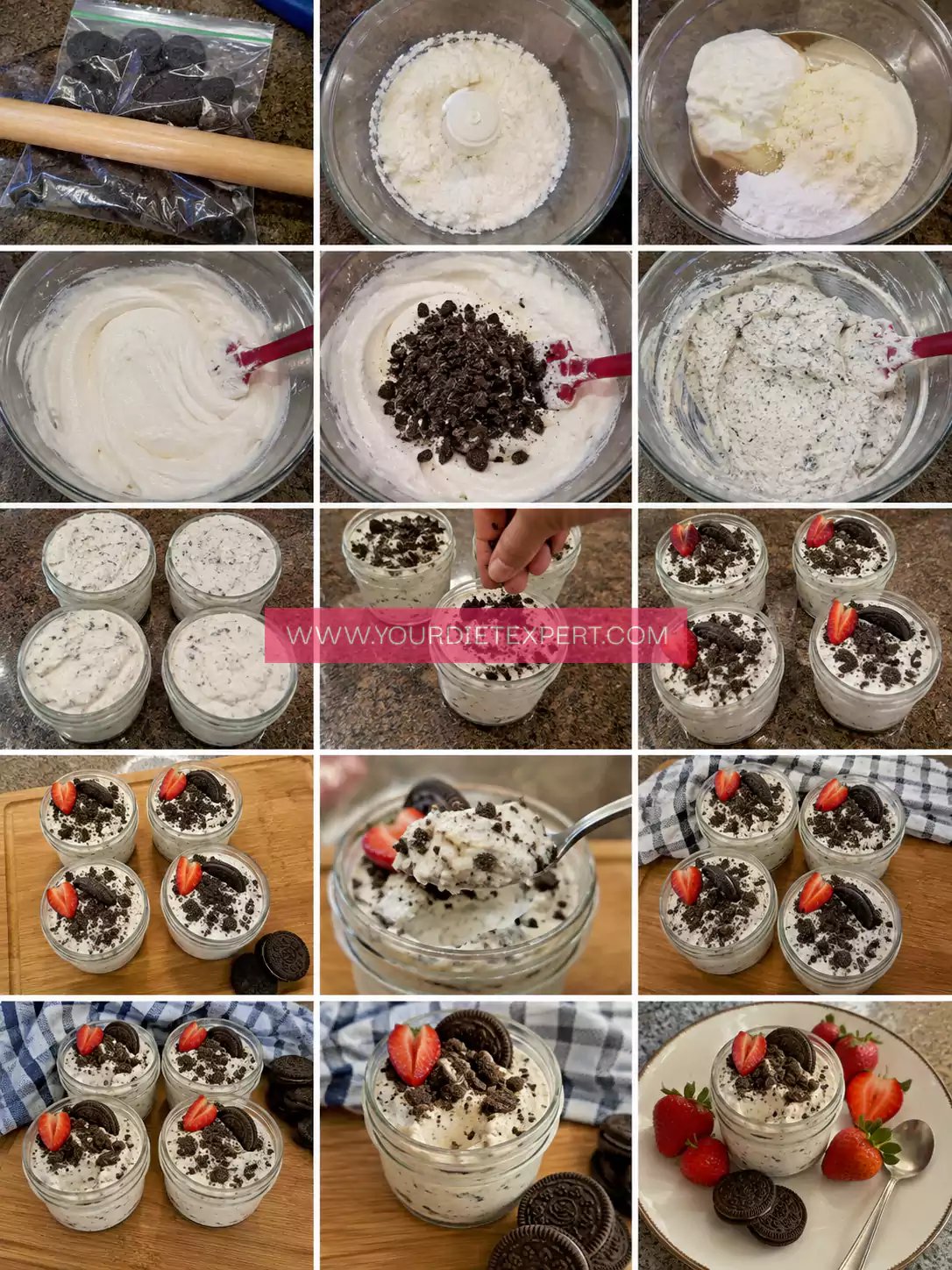
Step 1: Prepare the Cookies
Place the chocolate sandwich cookies into a resealable bag.
Crush them gently using a rolling pin, glass, or another sturdy kitchen tool.
Aim for a combination of fine crumbs and small pieces.
The fine crumbs add chocolate flavor throughout the fluff, while the larger pieces provide texture.
Reserve a small amount for the topping.
Step 2: Blend the Cottage Cheese
Add the cottage cheese to a high-speed blender or food processor.
Blend for approximately 1–2 minutes.
Stop and scrape the sides if necessary.
Continue blending until the cottage cheese looks completely smooth.
There should be no obvious curds remaining.
Step 3: Combine the Creamy Ingredients
Transfer the blended cottage cheese to a large mixing bowl.
Add:
- Greek yogurt
- Vanilla protein powder
- Cheesecake pudding mix
- Vanilla extract
Stir slowly until everything is combined.
Step 4: Adjust the Consistency
Add almond milk one tablespoon at a time.
You want the mixture to be thick and fluffy, not runny.
If your Greek yogurt is very thick or your protein powder absorbs a lot of liquid, you may need closer to four tablespoons.
Don’t add the entire amount automatically.
Step 5: Sweeten to Taste
Add one tablespoon of powdered sweetener.
Mix thoroughly.
Taste the mixture.
If you prefer a sweeter cheesecake flavor, add another tablespoon.
Remember that the cookies themselves contribute sweetness, so you may need less sweetener than expected.
Step 6: Fold in the Cookie Pieces
Once the cheesecake mixture has reached the consistency you want, add most of the crushed cookies.
Use a rubber spatula to gently fold them through the mixture.
Don’t vigorously stir at this stage. Gentle folding keeps the mixture light and fluffy while distributing the cookie pieces evenly.
Leave a small amount of cookie crumbs aside for the topping.
Texture Tip
I recommend keeping some pieces slightly larger than the rest.
Those little chocolate-cookie pockets are what make the dessert feel like a genuine cookies-and-cream treat rather than simply vanilla protein pudding.
Step 7: Taste and Adjust
Give the mixture one final taste before portioning it.
You can adjust several things at this stage:
More cheesecake flavor: Add a tiny amount of lemon juice or extra cheesecake pudding mix.
More vanilla: Add another ¼ teaspoon vanilla extract.
More sweetness: Add a little additional powdered sweetener.
More chocolate flavor: Add a teaspoon of unsweetened cocoa powder.
Be conservative with additions because small changes can significantly affect the final texture.
Step 8: Portion the Fluff
Divide the cheesecake fluff between 4 individual containers.
Alternatively, transfer everything to one larger serving bowl.
Individual portions are particularly useful for meal prep because they make calorie and protein tracking easier.
Step 9: Add the Toppings
Sprinkle the reserved cookie crumbs over each serving.
You can also add a few mini chocolate chips or chocolate shavings if desired.
For a more colorful presentation, add a couple of fresh strawberries.
The strawberries aren’t necessary for the recipe, but their bright color looks beautiful against the creamy chocolate-and-vanilla base.
Step 10: Chill
Cover the containers and refrigerate for at least 30 minutes.
For the best texture, I actually prefer chilling the fluff for around 1–2 hours.
During this time, the protein powder and pudding mix continue to absorb moisture, allowing the mixture to become thicker.
Step 11: Serve Cold
Remove the cheesecake fluff from the refrigerator and give it a quick stir if needed.
Serve immediately.
The finished texture should be:
- Thick
- Creamy
- Light
- Fluffy
- Slightly tangy
- Filled with crunchy cookie pieces
That’s exactly the combination we’re looking for.
Health & Nutrition Insights 💪
Dessert doesn’t need to be the nutritional opposite of everything else you eat.
A balanced eating pattern can include foods that are enjoyable while still prioritizing protein, fiber-rich foods, fruits, vegetables, and overall nutrient quality.
This High-Protein Cookies and Cream Cheesecake Fluff is designed around that idea.
It isn’t meant to replace a balanced meal, but it can be a much more protein-conscious dessert than many traditional cheesecake or ice cream options.
Protein for Muscle Recovery and Maintenance
The biggest nutritional advantage comes from the combination of Greek yogurt, cottage cheese, and protein powder.
Protein supplies amino acids that your body uses to maintain and repair muscle tissue.
For people who regularly perform resistance training, consuming enough total daily protein is an important part of supporting muscle development and recovery.
This dessert gives you another convenient way to contribute to that daily target.
Rather than relying exclusively on chicken, eggs, fish, or protein shakes, you can build variety into your routine with a sweet option.
A More Satisfying Dessert
Traditional desserts often contain substantial amounts of refined carbohydrates and added fats while providing relatively little protein.
This recipe reverses that balance.
The protein-rich dairy ingredients and protein powder make the dessert substantially more filling than a small serving of conventional cookies-and-cream pudding.
That doesn’t mean it has unlimited appetite-control properties. Your overall dietary pattern still matters.
However, protein is generally more satiating than carbohydrate or fat, which is one reason protein-rich snacks can be useful between meals.
Calcium and Dairy Nutrition
Cottage cheese and Greek yogurt naturally provide calcium and phosphorus.
Calcium is important for normal bone function, while phosphorus contributes to bones and teeth as well as several physiological processes.
Depending on the dairy products you choose, you may also get vitamin B12 and other micronutrients.
Why Greek Yogurt Works So Well
Greek yogurt is particularly useful in high-protein recipes because much of its liquid whey has been removed during processing, leaving a thicker product with a higher protein concentration than many regular yogurts.
That thickness also works in our favor.
It helps create a spoonable cheesecake texture without requiring heavy cream.
Cottage Cheese Adds Protein and Creaminess
Cottage cheese has become increasingly popular in high-protein recipes because it is both nutrient-dense and remarkably versatile.
When eaten straight from the container, the curds are obvious.
Once blended, however, they essentially disappear.
The result is a smooth base that works particularly well in:
- Cheesecake fillings
- Protein ice cream
- Smooth dips
- Dessert bowls
- Protein mousses
For this recipe, blending is the key.
Keeping Added Sugar Under Control
The cookies contribute some sugar, but the recipe doesn’t require large quantities of sugar or syrup.
Using powdered monk fruit, allulose, or another preferred low-sugar sweetener can reduce added sugar further.
If you use regular cookies and sweetened yogurt, the carbohydrate and sugar content will be higher.
That’s perfectly fine if those ingredients fit your overall eating pattern.
The important thing is to calculate the recipe based on the ingredients you actually use.
Satiety and Energy
A high-protein snack can be particularly useful when you’re trying to avoid the cycle of eating something sweet and becoming hungry again shortly afterward.
The combination of protein and dairy creates a more substantial snack than cookies alone.
For additional staying power, pair a serving with fresh berries or a small amount of nuts.
A Note About Hormones and Metabolism
Protein is sometimes promoted online as a food that automatically “boosts metabolism” or “balances hormones.”
The reality is more nuanced.
Adequate protein intake can support muscle mass, and maintaining muscle is relevant to energy expenditure and physical function.
Protein also has a relatively high thermic effect compared with carbohydrates and fats, meaning the body uses energy to digest and process it.
However, no individual dessert can “balance hormones” or dramatically speed up metabolism.
Your overall calorie intake, activity level, sleep, stress, body composition, and dietary pattern all play much larger roles.
That’s why I prefer to describe this recipe as a protein-rich dessert that supports a balanced eating pattern, rather than making exaggerated health promises.
High-Protein Plan & Macro Insights 📊
This recipe can be especially useful if you’re trying to increase your daily protein intake without eating another savory meal.
Assuming the recipe makes 4 servings, each portion can provide approximately 25–30 grams of protein, depending on your specific cottage cheese, Greek yogurt, and protein powder.
That makes one serving substantial enough to function as a high-protein snack or dessert.
Estimated Macros Per Serving
For the recipe as written, a reasonable estimate is:
- Calories: 270–300
- Protein: 27–30 g
- Fat: 5–7 g
- Carbohydrates: 22–26 g
- Fiber: 1–2 g
These values are estimates.
The biggest variables are the cookies, protein powder, yogurt, and cottage cheese.
For accurate tracking, always calculate the recipe using the nutrition labels of your exact ingredients.
For Fat Loss
If you’re eating in a calorie deficit, the easiest way to modify this dessert is to control the toppings and cookie quantity.
You can:
- Use fat-free Greek yogurt.
- Choose low-fat or fat-free cottage cheese.
- Use a lower-calorie protein powder.
- Use reduced-sugar cookies.
- Keep the serving size consistent.
- Skip additional chocolate toppings.
You still get the creamy cookies-and-cream experience without turning one serving into a very calorie-dense dessert.
For Muscle Building
If you’re intentionally eating more calories to support muscle growth, you can make the dessert more substantial.
Try adding:
- Additional cookie crumbs
- Chopped nuts
- Peanut butter
- High-protein granola
- Extra Greek yogurt
You could also serve it alongside a banana or berries for additional carbohydrates.
For Weight Maintenance
A single serving works beautifully as an evening dessert.
Because it contains a substantial amount of protein, it can also be used as an afternoon snack when your next meal is still several hours away.
When Is the Best Time to Eat It?
There’s no magical timing requirement.
The best time is the time that helps you consistently meet your overall nutrition goals.
After a Workout
A serving can contribute protein to your post-workout intake.
If your next meal isn’t immediately available, this can be a convenient option.
Afternoon Snack
This is one of my favorite uses.
Instead of reaching for cookies or candy in the afternoon, you can have a chilled serving of cheesecake fluff.
Evening Dessert
The creamy texture and cookie pieces make it especially satisfying after dinner.
Weekend Treat
Prepare individual containers on Sunday and have dessert ready throughout the week.
How It Fits Into a High-Protein Day
You don’t need to eat protein powder in every meal to follow a high-protein diet.
Instead, think about distributing protein throughout the day.
For example:
Breakfast: Eggs with Greek yogurt and fruit
Lunch: Grilled chicken, vegetables, and rice
Afternoon snack: High-Protein Cookies and Cream Cheesecake Fluff
Dinner: Lean beef, roasted vegetables, and potatoes
Evening snack: Cottage cheese with berries
The dessert becomes one part of a broader nutrition strategy.
Why It Works for Fitness Meal Prep
Meal prep isn’t only about chicken, rice, and vegetables.
Dessert preparation can be equally useful.
If you’re trying to follow a structured eating plan, having something sweet already portioned can prevent the need to make an unplanned dessert decision when cravings appear.
Prepare four containers at once.
Store them toward the front of the refrigerator.
Then you have an easy option available whenever you want something sweet.
How to Adjust the Macros
Increase Protein
Add another 1–2 tablespoons of protein powder.
If the mixture becomes too thick, add a small amount of milk.
Another option is increasing the Greek yogurt slightly.
Reduce Calories
Use fat-free dairy products and reduce the cookie topping.
You can also use a lower-calorie cookie alternative.
Increase Calories
Add:
- Nut butter
- Chopped nuts
- Extra cookie pieces
- Chocolate chips
These additions increase calories quickly, so portion accordingly.
Lower Carbohydrates
Use a low-carbohydrate cookie alternative and an unsweetened or low-carbohydrate yogurt.
Check the nutrition labels rather than relying solely on marketing terms.
A Better Way to Think About “Healthy Dessert”
I don’t believe a dessert needs to be completely sugar-free, fat-free, or made from only “clean” ingredients to be part of a healthy diet.
Food isn’t simply divided into good and bad categories.
Instead, think about the overall pattern.
If most of your diet is built around nutrient-dense foods and you regularly consume enough protein, fiber, fruits, vegetables, and appropriate amounts of dietary fat and carbohydrates, there’s room for enjoyable foods too.
That’s what I love about this recipe.
It takes a traditionally indulgent flavor and builds it around protein-rich ingredients.
You still get cookies and cream.
You still get cheesecake flavor.
You still get a creamy dessert.
You’re simply changing the nutritional foundation.
Serving + Pairing Ideas 🍪
This High-Protein Cookies and Cream Cheesecake Fluff is delicious straight from the refrigerator, but you can make it feel even more like a proper dessert with a few simple toppings. Since the base is creamy and rich, I like pairing it with something fresh or adding a small amount of crunch for contrast.
Add Fresh Berries
Fresh strawberries, raspberries, or blueberries provide a bright contrast to the rich chocolate-cookie flavor.
Strawberries are particularly good because their slight acidity balances the sweetness of the cookies.
For a simple serving, spoon the cheesecake fluff into a small glass or bowl and top with:
- 2–3 sliced strawberries
- A few blueberries
- A sprinkle of crushed cookies
Make a Cookies and Cream Sundae
For a more indulgent presentation, layer the fluff with:
- Crushed chocolate cookies
- Greek yogurt
- Fresh berries
- A small amount of whipped topping
- Dark chocolate shavings
Use a clear glass if you’re serving this to guests. The layers make a simple protein dessert look much more elaborate than it actually is.
Add a Chocolate Crunch
If you enjoy texture, sprinkle a small amount of chopped dark chocolate, cacao nibs, or crushed chocolate cookies over the top.
The creamy cheesecake base becomes much more interesting when you get a little crunch in every few bites.
Pair With Greek Yogurt
For an especially protein-rich snack, serve half a portion of the fluff alongside a small bowl of plain Greek yogurt and berries.
This is useful when you’re looking for something more substantial than dessert but don’t want a full meal.
Turn It Into a Protein Parfait
Layer the ingredients in a meal-prep jar:
- Cheesecake fluff
- Crushed cookies
- Greek yogurt
- Fresh strawberries
- Another layer of cheesecake fluff
- A small cookie crumb topping
Keep the crunchy topping separate until you’re ready to eat if you want it to remain crisp.
Storage & Meal Prep Tips 🧊
One of the best things about this recipe is how well it fits into a meal-prep routine.
Refrigerator Storage
Transfer the cheesecake fluff into airtight containers and refrigerate.
It is best enjoyed within 3–4 days.
Because the recipe contains dairy, keep it refrigerated rather than leaving it at room temperature for extended periods.
Keep Cookie Crumbs Separate
If you want the cookies to retain some crunch, don’t add all of them to the mixture before storing.
Instead, prepare the cheesecake base in advance and keep extra cookie crumbs in a separate small container.
Sprinkle them over the dessert immediately before serving.
Prepare Four Portions at Once
Divide the recipe into four equal containers immediately after mixing.
This makes portion control simple and gives you four ready-to-eat desserts.
It’s particularly convenient for Sunday meal prep.
Can You Freeze It?
I don’t recommend freezing this recipe as the primary storage method.
The dairy-based texture can change after freezing and thawing, potentially becoming watery or grainy.
For the best creamy cheesecake consistency, prepare smaller batches and keep them refrigerated.
Don’t Leave It Out Too Long
Since this is a dairy-based dessert, keep it chilled until you’re ready to eat.
If you’re taking it to work or somewhere without reliable refrigeration, use an insulated lunch bag with an appropriate cold pack.
Frequently Asked Questions ❓
Can I make this dairy-free?
Yes, although the recipe will need several substitutions.
Use a thick, high-protein dairy-free yogurt and a dairy-free cottage-cheese alternative if available. You can also use a plant-based protein powder.
Keep in mind that the protein content and texture may change significantly depending on the products.
A soy-based yogurt is generally a better protein choice than many coconut-based alternatives.
How much protein is in each serving?
The recipe provides approximately 27–30 grams of protein per serving when divided into four servings.
The exact amount depends on the protein powder, cottage cheese, and Greek yogurt you use.
For accurate nutrition tracking, calculate the recipe using the nutrition labels from your specific ingredients.
Can I use plant-based protein powder?
Absolutely.
Vanilla plant-based protein powder works well.
However, plant-based powders can absorb more liquid than whey protein.
Add the almond milk gradually until you reach the desired consistency.
You may need slightly more liquid than the recipe calls for.
Can I make this without cottage cheese?
Yes.
You can replace the cottage cheese with additional Greek yogurt or skyr.
However, the protein content and texture will change.
The cottage cheese is useful because, once blended, it creates a very smooth cheesecake-like base while adding substantial protein.
Can I use regular cookies instead of sugar-free cookies?
Yes.
In fact, the recipe as written can use regular chocolate sandwich cookies.
Just remember that regular cookies will generally increase the calories, carbohydrates, and sugar.
If you’re tracking macros closely, use the nutrition information from the exact cookies you’re adding.
Can I make this without protein powder?
You can, but it won’t be as high in protein.
If you omit the protein powder, increase the Greek yogurt or cottage cheese and adjust the consistency accordingly.
The finished dessert will still be creamy and delicious, but the protein content will be lower.
Can I make it ahead of time?
Yes.
This recipe is actually better after chilling for a little while.
Prepare it several hours before serving and keep it refrigerated.
The pudding mix and protein powder continue thickening the mixture as it rests.
Kitchen Tips & Troubleshooting Notes
How Do I Make the Cottage Cheese Completely Smooth?
Blend it by itself before adding the other ingredients.
Give it at least 1–2 minutes in a good blender or food processor, scraping down the sides as needed.
If you blend everything at once, the cookies and protein powder can make it harder to achieve an exceptionally smooth base.
Why Is My Cheesecake Fluff Too Thick?
Protein powder and pudding mix absorb liquid.
If the mixture becomes too thick, add 1 tablespoon of unsweetened almond milk and stir.
Repeat only if necessary.
A little liquid goes a long way.
Why Is My Fluff Too Thin?
First, refrigerate it for 30–60 minutes.
The mixture often thickens considerably as it chills.
If it remains too loose, add a small amount of Greek yogurt or protein powder and mix thoroughly.
Avoid adding a large amount of protein powder at once because it can create a dense texture.
How Do I Keep It Fluffy?
Don’t overmix once the cookies are added.
Fold them through gently with a spatula.
If you’re adding whipped topping, fold that in at the very end rather than aggressively stirring it.
Can I Make It More Chocolatey?
Yes.
Add 1–2 teaspoons of unsweetened cocoa powder.
You can also add a small amount of dark chocolate shavings or cacao nibs.
Remember that cocoa powder absorbs moisture, so you may need a small splash of milk.
Can I Make It More Like Cheesecake?
Add a little lemon juice and lemon zest.
The slight acidity creates a more pronounced cheesecake flavor.
You can also increase the cheesecake pudding mix slightly, but don’t add too much because it can make the dessert overly thick.
How Do I Get More Cookie Crunch?
Reserve about one-third of the crushed cookies.
Fold the remaining cookies into the mixture and sprinkle the reserved crumbs over the top immediately before serving.
This creates both soft cookie pieces inside and a crisp topping.
Nutrition Breakdown
Approximate nutrition per serving, based on 4 servings:
- Calories: 285
- Protein: 29 g
- Fat: 6 g
- Carbohydrates: 24 g
- Fiber: 1 g
- Sugar: 12 g
- Sodium: approximately 450 mg
These numbers are estimates and can vary considerably depending on the specific brands of cottage cheese, Greek yogurt, protein powder, cookies, and sweetener used.
For the most accurate nutrition information, enter the exact ingredients and quantities into your nutrition calculator.
Recipe Details
Prep Time: 10 minutes
Cook Time: 0 minutes
Chill Time: 30 minutes
Total Time: 40 minutes
Course: Dessert, Snack
Cuisine: American
Servings: 4
Calories: Approximately 285 per serving
Protein: Approximately 29 g per serving
Closing Note ❤️
This High-Protein Cookies and Cream Cheesecake Fluff is exactly the kind of dessert I love having in the refrigerator. It tastes indulgent enough to satisfy a serious cookies-and-cream craving, yet the base is built around cottage cheese, Greek yogurt, and protein powder rather than heavy cream and large amounts of added sugar.
What makes it even better is how easy it is to customize. You can make it more chocolatey, add strawberries, increase the cookie crunch, or adjust the sweetness depending on what you’re craving.
For me, healthy eating works best when there’s room for foods that genuinely taste good. You shouldn’t have to choose between enjoying dessert and making protein a priority.
This recipe gives you both.
Make a batch, divide it into individual containers, and keep it chilled for those moments when you want something creamy, chocolatey, and satisfying.
Enjoy every spoonful! ❤️
Ingredients
Method
- Place the chocolate sandwich cookies in a resealable bag and crush them into a mixture of fine crumbs and small pieces. Reserve a small amount for topping.
- Add the cottage cheese to a high-speed blender or food processor and blend for 1–2 minutes until completely smooth and creamy, scraping the sides as needed.
- Transfer the blended cottage cheese to a large mixing bowl and add the Greek yogurt, vanilla protein powder, sugar-free cheesecake pudding mix, and vanilla extract.
- Stir the mixture thoroughly until all the ingredients are evenly combined and the protein powder is fully incorporated.
- Add 1 tablespoon of powdered monk fruit sweetener or allulose and mix well. Taste the mixture and add another tablespoon if you prefer a sweeter dessert.
- Add the almond milk 1 tablespoon at a time, stirring after each addition, until the cheesecake mixture becomes thick, creamy, and spoonable without becoming runny.
- Fold most of the crushed chocolate cookies into the cheesecake mixture using a rubber spatula, keeping some cookie crumbs aside for the topping.
- Taste the mixture and adjust the sweetness, vanilla, or cheesecake flavor if desired.
- Divide the cheesecake fluff evenly among four individual serving containers or transfer it to one larger serving bowl.
- Sprinkle the reserved cookie crumbs over the top and add any optional toppings you prefer.
- Cover the containers and refrigerate for at least 30 minutes. For an even thicker texture, chill for 1–2 hours.
- Remove from the refrigerator when ready to serve and enjoy cold.
- Store leftovers in airtight containers in the refrigerator for up to 3–4 days.

Leave a Reply