
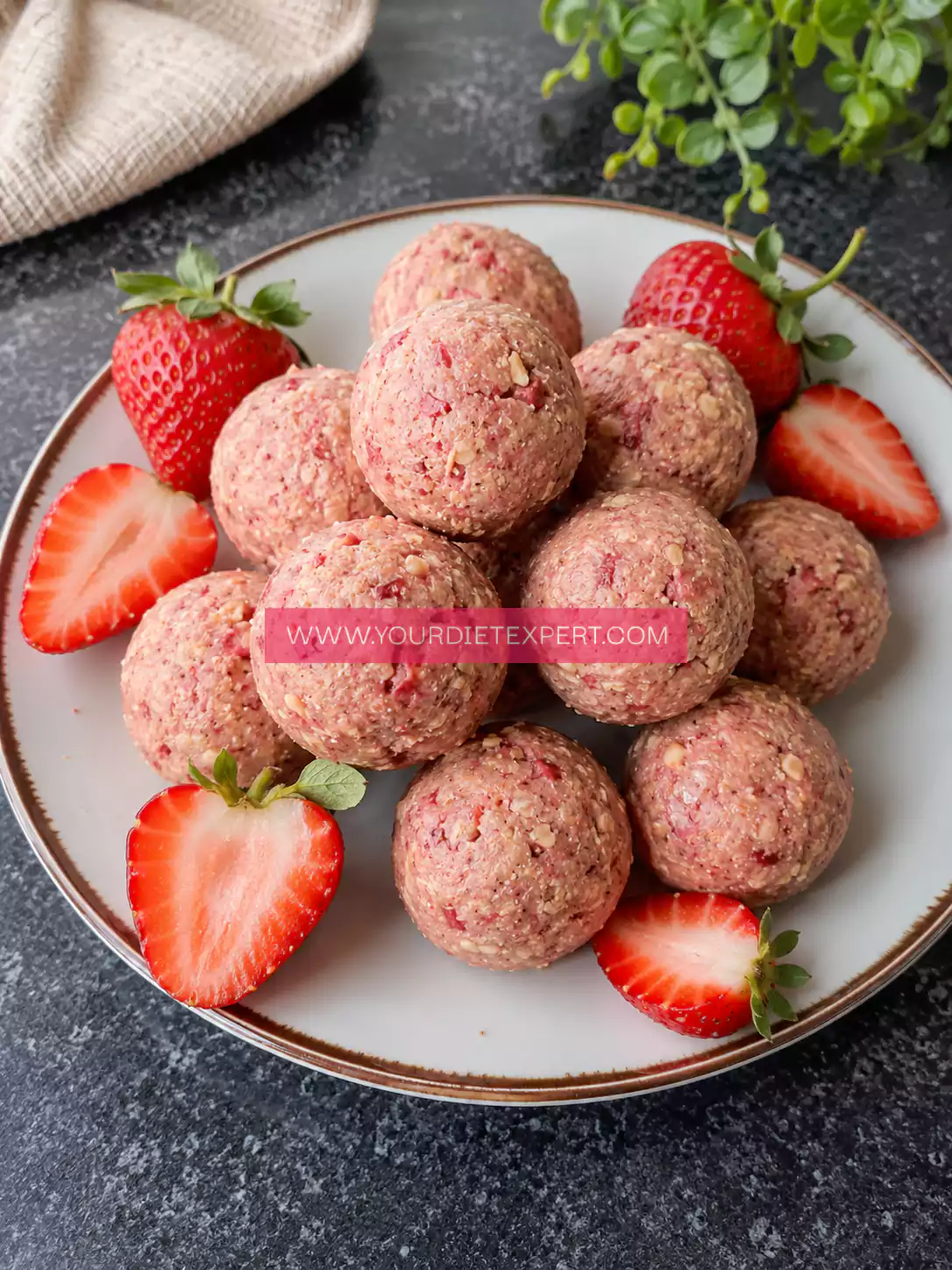
There are days when a sweet craving hits at exactly the wrong time—usually when I’m busy, between meals, or coming home from a workout—and that’s when having High-Protein Low-Carb Strawberry Protein Balls waiting in the refrigerator makes such a difference. These little bites are soft, slightly chewy, naturally strawberry-flavored, and satisfying enough to feel like a real treat rather than another “healthy snack.” They also make it much easier to increase protein intake without adding a large amount of sugar or refined carbohydrates to the day.
I especially love the combination of creamy, nutty flavor with bright strawberry pieces. The freeze-dried strawberries add little bursts of fruity sweetness throughout the mixture, while the protein powder and almond flour give the balls a soft, substantial texture. They’re the kind of snack you can grab with one hand when you’re rushing out the door, but they also look surprisingly pretty arranged on a small plate with fresh strawberries alongside them.
What makes these High-Protein Low-Carb Strawberry Protein Balls particularly useful is that they don’t require baking. There’s no oven to preheat, no complicated dough to prepare, and no waiting around for something to cook. Mix the ingredients, adjust the consistency, roll the mixture into balls, and chill. In a short amount of time, you’ve got a refrigerator-friendly snack that’s ready whenever your next protein craving appears.
What Makes This Recipe Stand Out
Protein balls are already convenient, but many store-bought versions contain considerable amounts of dates, honey, maple syrup, oats, or other carbohydrate-heavy ingredients.
This recipe takes a different approach.
Instead of relying on a large amount of sugar or dried fruit to hold everything together, it uses protein-rich ingredients and a small amount of moisture to create a soft, cohesive mixture.
High in Protein
The biggest reason to make these is right in the name.
Protein powder provides the majority of the protein, while Greek yogurt and nut-based ingredients contribute additional protein and help create a satisfying texture.
Depending on the protein powder and exact ingredients you use, each ball can provide approximately 10–12 grams of protein when the recipe is divided into 12 portions.
That makes two balls a convenient 20–24 gram protein snack.
Lower in Carbohydrates
Traditional energy balls often rely on dates, oats, dried fruit, honey, or maple syrup.
Those ingredients can be nutritious, but they can also push the carbohydrate content considerably higher.
Here, we’re using ingredients such as:
- Almond flour
- Protein powder
- Freeze-dried strawberries
- Unsweetened nut butter
- Greek yogurt
- Low- or zero-sugar sweetener
The result is a strawberry snack that keeps carbohydrates much lower than many conventional energy-ball recipes.
No Baking Required
There’s something especially convenient about a recipe that doesn’t require an oven.
You simply mix, roll, and chill.
That makes these protein balls ideal for:
- Busy mornings
- Office snacks
- Pre-workout fuel
- Post-workout recovery
- Afternoon cravings
- Weekend meal prep
Strawberry Flavor Without Strawberry Syrup
I wanted the strawberry flavor to taste like actual strawberries rather than an artificially sweet strawberry candy.
Freeze-dried strawberries work beautifully here because they’re concentrated, naturally fruity, and contain very little moisture.
That means they add intense strawberry flavor without making the mixture wet or difficult to roll.
Easy to Customize
Once you’ve made the base recipe, it’s incredibly easy to change the flavor.
You can add:
- Unsweetened coconut
- Chopped almonds
- Cacao nibs
- Sugar-free white chocolate chips
- Lemon zest
- Chia seeds
You can also experiment with vanilla, strawberry, or unflavored protein powder depending on what you have available.
Perfect for Meal Prep
These protein balls are one of those recipes I like making before the week gets busy.
A single batch gives you multiple individually portioned snacks.
Instead of opening the pantry every afternoon and searching for something that fits your nutrition goals, you can simply reach into the refrigerator and grab one or two.
That small amount of preparation can make healthy eating much easier to maintain.
My Personal Blogger Note
I first started making protein balls because I wanted something more interesting than a protein shake after exercising. I enjoy shakes, but having the same liquid snack day after day can get boring. I wanted something I could actually chew—something sweet, portable, and satisfying without turning into a full dessert.
The strawberry version quickly became one of my favorites.
There is something about strawberry and vanilla together that makes a simple protein snack taste almost like a dessert. Once I added finely crushed freeze-dried strawberries to the mixture, the flavor became much more noticeable. Every bite had little pieces of strawberry throughout it, which made the texture much more enjoyable.
I also love that these don’t need to be perfect.
Some days I make small, uniform balls for meal prep. Other times they’re slightly different sizes because I’m making them quickly before heading out. Either way, they taste great.
That’s exactly what I want from a healthy snack: something nutritious enough to support my goals but simple enough that I will actually keep making it.
Equipment Needed
You don’t need a kitchen full of equipment for this recipe. A few basic tools are enough.
Mixing Bowl
Use a medium or large mixing bowl with enough room to stir the dry ingredients and wet ingredients together without spilling.
A wider bowl is particularly helpful once the mixture becomes thick.
Food Processor
A food processor is optional but useful for breaking freeze-dried strawberries into smaller pieces.
You can also place them in a resealable bag and crush them with a rolling pin if you don’t want to use another appliance.
Measuring Cups and Spoons
Accurate measurements are especially important with protein balls because the balance between dry and wet ingredients determines whether the mixture rolls properly.
Too much protein powder can make them dry, while too much liquid can make them sticky.
Rubber Spatula
A sturdy spatula makes it easier to combine the thick mixture and scrape the sides of the bowl.
Small Cookie Scoop
A cookie scoop isn’t essential, but it’s incredibly useful for making evenly sized protein balls.
Consistent portions also make macro tracking easier.
Baking Sheet or Large Plate
Use this to place the finished balls before chilling.
Line it with parchment paper to prevent sticking.
Airtight Storage Container
A sealed container keeps the protein balls fresh in the refrigerator and prevents them from absorbing odors from other foods.
Ingredients with Substitutions
The ingredient list is deliberately simple, but each ingredient plays an important role in the final texture and nutrition.
Vanilla Protein Powder – 1½ cups
Protein powder forms the primary high-protein base of the recipe.
A smooth vanilla whey protein isolate works particularly well because it creates a soft texture without requiring a large amount of sweetener.
Substitutions
You can use:
- Whey concentrate
- Plant-based vanilla protein powder
- Unflavored protein powder
- Strawberry protein powder
Plant-based protein powders often absorb more liquid, so you may need an additional tablespoon or two of Greek yogurt or almond milk.
Almond Flour – ½ cup
Almond flour provides structure and healthy fats while keeping the carbohydrate content relatively low.
It also gives the protein balls a soft, slightly nutty texture.
Substitutions
You can replace it with:
- Finely ground almonds
- Sunflower seed flour
- Coconut flour
Be careful with coconut flour because it absorbs substantially more liquid than almond flour. If using it, start with a smaller amount and adjust gradually.
Natural Unsweetened Peanut Butter – ½ cup
Peanut butter contributes healthy fats, some additional protein, and the creamy texture that helps bind the mixture.
The subtle peanut flavor also works surprisingly well with strawberries.
Substitutions
Use:
- Almond butter
- Cashew butter
- Sunflower seed butter
For the lowest carbohydrate option, choose a nut or seed butter without added sugar.
Plain Greek Yogurt – ¼ cup
Greek yogurt provides moisture while adding additional protein and a slight tang.
That tang helps balance the sweetness of the strawberries and protein powder.
Substitutions
You can use:
- Skyr
- High-protein yogurt
- Dairy-free high-protein yogurt
Dairy-free alternatives may slightly change the protein content.
Freeze-Dried Strawberries – ⅓ cup
This is the ingredient that gives these protein balls their signature strawberry flavor.
Crush some of the strawberries finely and leave a few pieces slightly larger.
That creates little bursts of strawberry throughout each bite.
Substitutions
You can use freeze-dried raspberries or blackberries, although the flavor profile will obviously change.
Avoid replacing them with a large amount of fresh strawberries because the extra moisture can make the mixture too wet.
Powdered Monk Fruit or Allulose – 2 tablespoons
The exact amount depends on how sweet your protein powder is.
A powdered sweetener blends more smoothly than granulated sweetener.
Substitutions
You can use:
- Powdered erythritol
- Stevia blend
- Allulose
- Another preferred sugar-free sweetener
Vanilla Extract – 1 teaspoon
Vanilla enhances both the strawberry and creamy flavors.
Even a small amount makes the finished protein balls taste more dessert-like.
Unsweetened Almond Milk – 2–4 tablespoons, as needed
You may not need all of it.
Add the almond milk gradually until the mixture becomes soft enough to roll but isn’t wet or sticky.
Substitutions
Use:
- Skim milk
- High-protein milk
- Unsweetened soy milk
- Another unsweetened milk alternative
Optional Lemon Zest – ½ teaspoon
A small amount of lemon zest makes the strawberry flavor brighter.
It’s particularly good if you want these to taste more like strawberry cheesecake.
Optional Coating
For an attractive finish, roll the finished balls in:
- Finely crushed freeze-dried strawberries
- Unsweetened shredded coconut
- Finely chopped almonds
- Crushed pistachios
This isn’t necessary, but it makes them look much more special when serving guests.
Step-by-Step Cooking Process
Making these High-Protein Low-Carb Strawberry Protein Balls is mostly about getting the consistency right. There is no baking involved, so you can have the entire batch mixed, shaped, and chilling in a relatively short amount of time.
The key is to add moisture gradually. Protein powder, almond flour, and freeze-dried strawberries all absorb liquid differently, so adding everything at once can make it difficult to correct the texture.
Step 1: Prepare the Strawberries
Place the freeze-dried strawberries in a small food processor and pulse several times.
You want a mixture containing mostly small strawberry pieces with a little strawberry powder.
Don’t turn everything into a completely fine powder.
Those small pieces are what give the finished protein balls little bursts of strawberry flavor.
If you don’t have a food processor, place the strawberries inside a resealable bag and gently crush them with a rolling pin or the bottom of a glass.
Set aside about 1 tablespoon of the crushed strawberries if you’d like to coat the finished protein balls.
Step 2: Combine the Dry Ingredients
Add the following to a large mixing bowl:
- Vanilla protein powder
- Almond flour
- Crushed freeze-dried strawberries
- Powdered monk fruit sweetener
- Optional lemon zest
Whisk everything together thoroughly.
This distributes the strawberry pieces and sweetener evenly before you add the wetter ingredients.
Why This Matters
Protein powder can form little pockets when it comes into contact with moisture.
Mixing the dry ingredients first helps prevent those pockets and gives you a much smoother finished mixture.
Step 3: Add the Peanut Butter
Add the unsweetened peanut butter to the dry mixture.
If your peanut butter is very firm, warm it gently for 10–15 seconds in the microwave.
It should be soft and stirrable, not hot.
Mix it into the dry ingredients using a rubber spatula.
At this point, the mixture will look crumbly.
That’s completely normal.
Step 4: Add the Greek Yogurt
Add the Greek yogurt and vanilla extract.
Stir thoroughly.
The mixture should begin coming together into a thick dough.
Don’t add all of the almond milk yet.
You want to see how much moisture the yogurt and peanut butter provide first.
Step 5: Add Almond Milk Gradually
Add 1 tablespoon of unsweetened almond milk.
Mix well.
If the mixture still looks dry and crumbly, add another tablespoon.
Continue this process until the mixture begins sticking together when pressed between your fingers.
You may need anywhere from 2–4 tablespoons depending on your protein powder and almond flour.
Important Tip
Don’t pour all four tablespoons in at once.
A mixture that’s slightly too dry is easy to fix.
A mixture that’s too wet may require considerably more protein powder or almond flour, which can alter the flavor and nutrition.
Step 6: Test the Consistency
Take about one tablespoon of the mixture and squeeze it firmly in your hand.
If it holds together without cracking apart, you’ve reached the right consistency.
The mixture should feel:
- Soft
- Slightly tacky
- Easy to compress
- Firm enough to roll
It shouldn’t feel wet or excessively sticky.
Step 7: Fix a Dry Mixture
If the mixture refuses to hold together, don’t worry.
Add one of these:
- 1 teaspoon Greek yogurt
- 1 teaspoon peanut butter
- 1 teaspoon almond milk
Mix again.
Continue adding tiny amounts until the mixture holds together.
Why Small Additions Work Better
Protein powder absorbs moisture quickly.
Adding liquid slowly gives you much greater control over the final texture.
Step 8: Fix a Sticky Mixture
If you’ve accidentally added too much liquid, the solution is just as simple.
Add:
- 1 tablespoon protein powder
- Or 1 tablespoon almond flour
Mix thoroughly.
Allow the mixture to sit for 2–3 minutes before deciding whether it needs more.
The dry ingredients continue absorbing moisture after mixing.
Step 9: Chill the Mixture Before Rolling
Place the bowl in the refrigerator for approximately 10–15 minutes.
This step is optional, but I highly recommend it.
Chilling allows the almond flour and protein powder to absorb additional moisture.
It also makes the mixture easier to handle.
Step 10: Portion the Mixture
Use a small cookie scoop or tablespoon to portion the mixture.
For approximately 12 protein balls, use around 1½ tablespoons of mixture per ball.
If you’re tracking calories or protein closely, weighing the mixture and dividing it equally provides the most consistent portions.
Step 11: Roll Into Balls
Roll each portion between your palms using gentle circular movements.
Don’t squeeze excessively.
The goal is to create compact balls without making them overly dense.
If the mixture begins sticking to your hands, lightly dampen your palms with water.
Step 12: Add the Strawberry Coating
For an extra strawberry finish, roll each ball through the reserved crushed freeze-dried strawberries.
Press gently so the pieces adhere to the surface.
You can also coat some with unsweetened coconut or finely chopped almonds.
Step 13: Chill the Finished Protein Balls
Arrange the balls on a parchment-lined plate or small baking sheet.
Refrigerate for at least 30 minutes.
This gives them time to firm up and allows the flavors to blend.
Step 14: Serve
Once chilled, they’re ready to enjoy.
The texture should be soft and chewy with little bursts of strawberry throughout.
For the best flavor, allow them to sit at room temperature for approximately 5 minutes before eating.
Health & Nutrition Insights 💪
A good protein snack should do more than simply contain protein.
It should also be enjoyable enough that you actually want to eat it consistently.
These strawberry protein balls combine protein, fats, and a small amount of carbohydrate from the strawberries to create a convenient snack that can fit into a balanced eating pattern.
Protein Supports Muscle Repair
Protein provides amino acids that your body uses to repair and maintain muscle tissue.
That’s especially relevant if you’re regularly performing resistance training.
Eating an adequate amount of protein throughout the day is more important than relying on one enormous protein-heavy meal.
These protein balls can make it easier to distribute protein between meals.
A Convenient Way to Increase Protein
One of the biggest challenges with high-protein eating is finding variety.
Chicken, eggs, fish, yogurt, cottage cheese, and protein shakes are useful, but eating the same foods repeatedly can become boring.
A strawberry protein ball gives you another option.
You can have one or two alongside a meal or use them as a snack between meals.
Healthy Fats Add Staying Power
Almond flour and peanut butter provide dietary fat.
Fat is energy-dense and can contribute to satiety, which is one reason these little balls can feel surprisingly satisfying for their size.
The key is portion awareness because nut butters and almond flour are calorie-dense.
Strawberries Add Fruit Nutrition
Freeze-dried strawberries retain much of the nutritional value of fresh strawberries while becoming significantly more concentrated by weight.
They contribute:
- Vitamin C
- Manganese
- Fiber
- Plant compounds
- Natural strawberry flavor
Because they contain much less water than fresh fruit, they are particularly useful in no-bake recipes.
Lower Sugar Than Traditional Energy Balls
Many traditional energy balls depend heavily on dates, honey, maple syrup, or sweetened dried fruit.
Those ingredients aren’t inherently unhealthy, but they can significantly increase the sugar and carbohydrate content.
This recipe relies primarily on protein powder, strawberries, nut butter, and a low- or zero-sugar sweetener.
That makes it a useful alternative for people intentionally limiting added sugar.
Protein Can Support Satiety
Protein is generally more satiating than carbohydrate or fat on a calorie-for-calorie basis.
A protein-rich snack may therefore help you feel satisfied between meals.
However, no single food guarantees appetite control or fat loss. Your overall calorie intake, food quality, activity, sleep, and dietary pattern all matter.
A Useful Snack Around Exercise
These protein balls can fit either before or after training depending on your overall diet.
Before a Workout
One ball can provide a convenient snack if you need something small before training.
If you need more carbohydrate for demanding training, pair it with fruit such as a banana.
After a Workout
Two balls can provide a convenient protein-rich snack while you prepare a larger meal.
High Protein Plan & Macro Insights 📊
These High-Protein Low-Carb Strawberry Protein Balls are particularly useful when you’re following a protein-focused meal plan because they’re easy to portion and don’t require cooking once prepared.
The exact nutrition will depend heavily on the protein powder and peanut butter you choose.
For that reason, treat the numbers below as estimates rather than laboratory measurements.
Estimated Nutrition Per Protein Ball
Assuming the recipe makes 12 balls, a reasonable estimate is approximately:
- Calories: 140–155
- Protein: 10–12 g
- Fat: 8–9 g
- Carbohydrates: 6–7 g
- Fiber: 2–3 g
- Net Carbs: approximately 3–5 g
Your actual numbers can differ considerably depending on the protein powder.
For precise tracking, enter the exact ingredients and quantities from your product labels into your preferred nutrition tracker.
Two Balls Make a Strong Protein Snack
If one ball provides approximately 10–12 grams of protein, two provide roughly:
20–24 grams of protein.
That makes two balls a particularly convenient snack between meals or after training.
For Fat Loss
If you’re reducing calories, portion control is important because peanut butter and almond flour are energy-dense.
A simple approach is:
1 protein ball + fresh berries
This gives you a sweet snack while keeping the portion relatively modest.
You can also use:
- Powdered peanut butter
- Lower-fat nut butter
- Fat-free Greek yogurt
to reduce calories, although the texture will change slightly.
For Muscle Building
If you’re intentionally eating more calories to support muscle growth, these can be easily incorporated into a larger snack.
Try:
2 protein balls + Greek yogurt + banana
This combination provides considerably more protein and carbohydrates than the balls alone.
For Weight Maintenance
Two protein balls can work well as an afternoon snack when your next meal is still several hours away.
They are much easier to portion than eating directly from a jar of peanut butter or a bag of snack foods.
When Should You Eat Them?
There isn’t one universally “best” time.
Morning
Pair one or two with Greek yogurt and berries for a quick breakfast component.
Mid-Morning
Enjoy one when breakfast was lighter than usual.
Afternoon
This is one of my favorite times for them because they can help bridge the gap between lunch and dinner.
Pre-Workout
One ball can work well when you want a small snack before exercising.
Post-Workout
Two balls provide a convenient dose of protein while you prepare a complete meal.
Evening
If you want something sweet after dinner, one portion can satisfy the craving without turning into a large dessert.
How to Build Them Into a High-Protein Day
A protein-focused day doesn’t have to mean eating protein at every opportunity.
Instead, distribute your intake across meals and snacks.
For example:
Breakfast: Greek yogurt bowl with berries and eggs
Lunch: Grilled chicken salad with quinoa
Snack: 2 Strawberry Protein Balls
Dinner: Grilled fish or chicken with vegetables and rice
Evening snack: Cottage cheese with berries
The protein balls become one small component of the overall plan rather than the entire strategy.
Why They Work for Fitness Meal Prep
These are especially convenient for fitness meal prep because there is no reheating.
Prepare a batch once, portion them, and keep them refrigerated.
You can then grab exactly what you need before:
- Going to the gym
- Leaving for work
- Running errands
- Starting a busy afternoon
- Heading out on a road trip
That convenience is often what makes a nutrition plan sustainable.
Macro Adjustments
The beauty of homemade protein balls is that you control the ingredients.
Want More Protein?
Increase the protein powder slightly, but add moisture gradually.
You can also use high-protein Greek yogurt.
Want Fewer Calories?
Reduce the peanut butter and use powdered peanut butter.
Want Lower Carbohydrates?
Choose a low-carb protein powder and unsweetened nut butter without added sugar.
Want More Fiber?
Add a small amount of:
- Chia seeds
- Ground flaxseed
- Psyllium husk
Start with a small amount because these ingredients absorb significant moisture.
Want More Strawberry Flavor?
Increase the freeze-dried strawberries rather than adding fresh strawberries.
Fresh strawberries introduce water and can make the mixture difficult to shape.
A Note About “Low-Carb” and “Zero-Carb”
It’s worth being precise here.
These protein balls can be low-carb, but they shouldn’t automatically be marketed as “zero-carb.”
Almond flour, strawberries, Greek yogurt, and protein powder naturally contain some carbohydrates.
Even if a particular ingredient label rounds a very small amount down to zero, the complete recipe still contains measurable carbohydrates.
For YourDietExpert, High-Protein Low-Carb Strawberry Protein Balls is therefore the more accurate and credible title.
Why Portion Size Matters
These are small, but they’re nutritionally concentrated.
Ingredients such as peanut butter and almond flour provide healthy fats, but they also contribute significant calories.
That isn’t a problem.
It simply means the appropriate serving depends on your individual calorie and protein requirements.
For someone wanting a small snack, one ball may be enough.
For someone who needs a substantial post-workout snack, two balls paired with fruit or Greek yogurt may make more sense.
Make Them Part of Your Routine
The biggest advantage isn’t that these protein balls are a magical fat-loss food.
They aren’t.
Their real advantage is convenience and consistency.
When you have a nutritious snack ready to eat, you’re less likely to reach for whatever happens to be easiest.
That can make maintaining a high-protein eating pattern significantly simpler over time.
Serving + Pairing Ideas 🍓
These High-Protein Low-Carb Strawberry Protein Balls are small enough to enjoy almost anywhere, which is exactly why I love keeping a batch in the refrigerator. They’re delicious straight from the fridge, but you can also turn them into a more substantial snack by pairing them with another protein-rich food or some fresh fruit.
Serve With Greek Yogurt
For a simple high-protein snack, place one or two strawberry protein balls alongside a bowl of plain Greek yogurt.
Add:
- Fresh strawberries
- A few blueberries
- Lemon zest
- Crushed almonds
The creamy yogurt works beautifully with the chewy strawberry protein balls.
Make a Strawberry Protein Snack Plate
For a more substantial snack plate, arrange:
- 2 protein balls
- Fresh strawberries
- Greek yogurt
- A small handful of almonds
- A few cucumber slices
This works particularly well when you want something satisfying between lunch and dinner.
Pair With Fresh Fruit
Fresh fruit adds moisture and natural sweetness.
Try pairing the balls with:
- Strawberries
- Raspberries
- Blueberries
- Blackberries
- Kiwi
Because the protein balls are relatively concentrated, fresh fruit provides a refreshing contrast.
Post-Workout Snack
For a convenient recovery snack, combine two protein balls with a banana or a serving of Greek yogurt.
The protein balls contribute protein and fat, while the fruit supplies carbohydrates that can complement your post-workout nutrition.
Make a Strawberry Cheesecake Version
If you want these to taste more like dessert, add a little lemon zest to the mixture and coat the finished balls with finely crushed freeze-dried strawberries.
You can also drizzle them very lightly with melted sugar-free white chocolate.
The combination of strawberry, vanilla, lemon, and white chocolate creates a cheesecake-inspired flavor.
Add Them to Breakfast
You don’t have to eat protein balls exclusively as snacks.
Try chopping one into pieces and serving it over:
- Greek yogurt
- Cottage cheese
- Chia pudding
- Protein oatmeal
The pieces add sweetness and texture without requiring additional preparation.
Storage & Meal Prep Tips 🧊
These protein balls are particularly convenient because they keep well in the refrigerator and don’t require reheating.
Refrigerator Storage
Place the finished protein balls in an airtight container.
Refrigerate for up to 7 days.
For the best texture, place parchment paper between layers if you’re stacking them.
Freezer Storage
You can also freeze them for longer storage.
Arrange the balls in a single layer on a parchment-lined plate or baking sheet and freeze for about 1–2 hours.
Once firm, transfer them to a freezer-safe container or bag.
They can be frozen for approximately 2–3 months.
How to Thaw Them
Move the desired portion from the freezer to the refrigerator several hours before eating.
You can also allow them to sit at room temperature for approximately 15–20 minutes.
Don’t microwave them.
The texture is best when they’re allowed to thaw naturally.
Weekly Meal Prep
I recommend making a batch at the beginning of the week.
Once shaped, divide them into small containers containing one or two balls each.
That gives you ready-made portions for:
- Work
- School
- Gym sessions
- Afternoon snacks
- Travel
Keep Them Away From Moisture
Store them in a sealed container and don’t place fresh strawberry slices inside with them.
Fresh strawberries release water, which can make the protein balls sticky and shorten their storage life.
Add fresh fruit only when you’re ready to eat.
Frequently Asked Questions ❓
Can I make these protein balls dairy-free?
Yes. Use a dairy-free protein powder and replace the Greek yogurt with a thick, unsweetened dairy-free yogurt.
Soy-based yogurt is a particularly useful option because it generally provides more protein than many coconut-based alternatives.
Keep in mind that the nutritional values will change depending on the products you choose.
How much protein is in each protein ball?
The recipe makes approximately 12 balls, with an estimated 10–12 grams of protein per ball.
The exact amount depends heavily on the protein powder, Greek yogurt, peanut butter, and almond flour used.
For precise tracking, calculate the nutrition using the labels from your specific ingredients.
Can I use plant-based protein powder?
Absolutely.
A vanilla or strawberry plant-based protein powder works well.
However, plant proteins tend to absorb more liquid than whey protein.
Start with the smaller amount of almond milk and add more only if necessary.
Can I use fresh strawberries?
I don’t recommend replacing all of the freeze-dried strawberries with fresh strawberries.
Fresh fruit contains considerably more water, which can make the mixture wet and difficult to roll.
If you’d like fresh strawberry flavor, finely chop a very small amount and consume the protein balls within a few days.
For the best texture, stick with freeze-dried strawberries in the mixture.
Are these keto-friendly?
They can potentially fit into a keto eating pattern depending on the specific protein powder, yogurt, sweetener, and strawberry quantities used.
However, don’t assume a recipe is keto simply because it’s labeled low-carb.
Calculate the total carbohydrates and net carbohydrates using your exact ingredients.
Can I make these without peanut butter?
Yes.
Almond butter, cashew butter, or sunflower seed butter are all good substitutes.
The flavor and nutrition will change slightly, but the basic method remains the same.
Kitchen Tips & Troubleshooting Notes
A few small adjustments can make the difference between perfectly soft protein balls and a mixture that’s frustrating to work with.
If the Mixture Is Too Dry
Add liquid very gradually.
Start with:
1 teaspoon Greek yogurt or almond milk.
Mix thoroughly before adding anything else.
Protein powder continues absorbing moisture for several minutes, so give the mixture time before making another adjustment.
If the Mixture Is Too Sticky
Add approximately 1 tablespoon of protein powder or almond flour.
Mix and wait for a few minutes.
Repeat only if necessary.
Avoid adding a large amount of dry ingredients at once because you can quickly end up with dense, dry protein balls.
If the Protein Powder Tastes Too Strong
Some protein powders have a very pronounced artificial sweetness.
You can balance that flavor with:
- Lemon zest
- A tiny pinch of salt
- Unsweetened peanut butter
- Additional freeze-dried strawberries
A small amount of lemon zest is particularly effective.
If the Balls Won’t Hold Their Shape
The mixture probably needs slightly more moisture or more time to hydrate.
Chill it for 10–15 minutes first.
If it still crumbles, add a teaspoon of Greek yogurt or nut butter.
If They’re Too Soft
Place the mixture in the refrigerator for another 15–20 minutes.
If it remains too soft, add a little protein powder or almond flour.
For a Smoother Texture
Use very finely ground almond flour and a smooth nut butter.
Crunchy peanut butter works, but it creates a more textured protein ball.
For More Strawberry Flavor
Use a combination of finely powdered freeze-dried strawberries and small strawberry pieces.
The powder distributes flavor throughout the mixture, while the larger pieces provide little bursts of fruit.
Nutrition Breakdown
Approximate nutrition per protein ball, based on 12 balls:
- Calories: 145
- Protein: 11 g
- Fat: 8 g
- Carbohydrates: 6 g
- Fiber: 2 g
- Net Carbs: 4 g
- Sugar: 2 g
These values are estimates. Protein powder, peanut butter, almond flour, and yogurt brands can vary considerably, so use your own ingredient labels for the most accurate calculation.
Recipe Details
Prep Time: 15 minutes
Chill Time: 30 minutes
Cook Time: 0 minutes
Total Time: 45 minutes
Course: Snack, Dessert, Breakfast
Cuisine: American
Servings: 12 protein balls
Calories: Approximately 145 per ball
Closing Note ❤️
These High-Protein Low-Carb Strawberry Protein Balls have become one of my favorite ways to make healthy snacking feel a little more exciting. They’re soft, nutty, fruity, and satisfying, with enough protein to make them genuinely useful as part of a protein-focused eating plan.
What I love most is how practical they are. There’s no oven to turn on, no complicated recipe to follow, and no long list of unusual ingredients. A few minutes of preparation gives you a refrigerator full of convenient snacks that can help you stay consistent throughout a busy week.
They’re also incredibly easy to customize. Make them more lemony, add coconut, use almond butter instead of peanut butter, or coat them in crushed strawberries. Once you have the basic mixture right, there are plenty of ways to make them your own.
Healthy eating doesn’t have to mean eating the same foods every day. Sometimes a small, flavorful snack is exactly what you need to make a high-protein lifestyle feel enjoyable and sustainable.
I hope these become a regular part of your meal prep too. ❤️

High-Protein Low-Carb Strawberry Protein Balls
Ingredients
Method
- Place the freeze-dried strawberries in a food processor and pulse until mostly finely crushed, leaving a few small pieces for texture. Alternatively, place them in a resealable bag and crush them gently with a rolling pin.
- Reserve approximately 1 tablespoon of the crushed strawberries if you want to coat the finished protein balls.
- Add the protein powder, almond flour, crushed strawberries, powdered monk fruit sweetener, and optional lemon zest to a large mixing bowl.
- Whisk the dry ingredients together thoroughly so the strawberry pieces and sweetener are evenly distributed.
- Add the peanut butter and stir with a rubber spatula until the mixture becomes crumbly and the peanut butter is incorporated.
- Add the Greek yogurt and vanilla extract and mix thoroughly until the ingredients begin forming a thick dough.
- Add 1 tablespoon of almond milk and mix completely before adding more.
- Continue adding almond milk one tablespoon at a time until the mixture holds together when pressed between your fingers. You may need between 2 and 4 tablespoons depending on the protein powder and almond flour.
- Test a small amount by squeezing it in your hand. The mixture should hold together without being wet or excessively sticky.
- If the mixture is too dry, add a teaspoon of Greek yogurt, peanut butter, or almond milk and mix again. If it is too sticky, add a tablespoon of protein powder or almond flour.
- Refrigerate the mixture for 10–15 minutes to allow the dry ingredients to absorb moisture and make shaping easier.
- Use a small cookie scoop or tablespoon to divide the mixture into approximately 12 equal portions.
- Roll each portion gently between your palms until it forms a smooth ball.
- Roll the finished balls through the reserved crushed freeze-dried strawberries or another optional coating if desired.
- Place the protein balls on a parchment-lined plate or baking sheet and refrigerate for at least 30 minutes.
- Serve chilled or allow them to sit at room temperature for about 5 minutes before eating for a softer texture.
- Store leftovers in an airtight container in the refrigerator for up to 7 days or freeze for up to 2–3 months.

Leave a Reply