
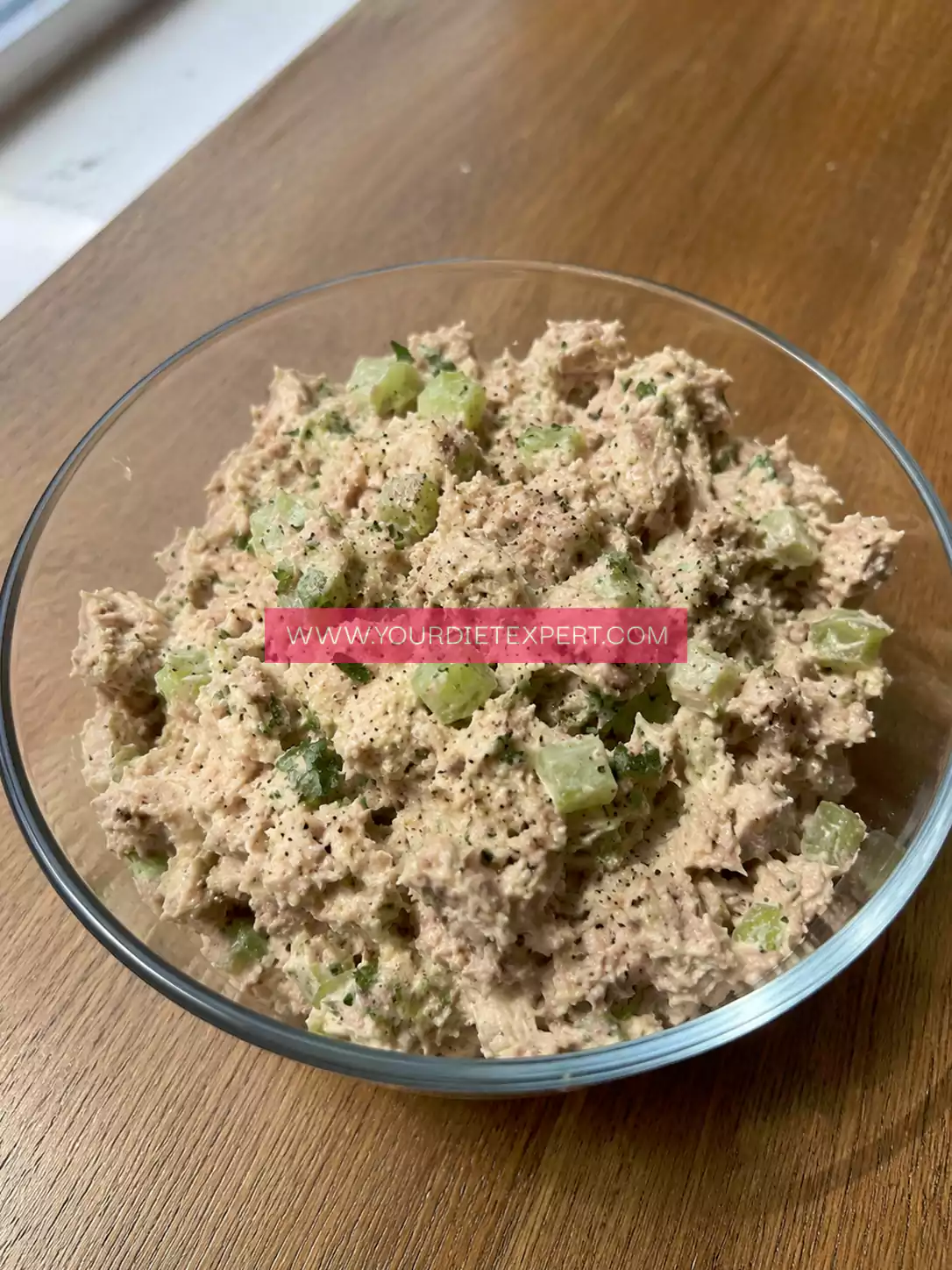
There are days when I want lunch to be incredibly simple, but I still want it to feel like a proper meal. That’s exactly where this 1g Carb High-Protein Tuna Salad comes in. It’s creamy, savory, fresh, and packed with tender tuna, while staying remarkably low in carbohydrates. A few minutes of mixing is all it takes to turn a handful of everyday ingredients into a filling, protein-rich meal.
I especially love having this tuna salad ready after a workout or on a busy afternoon when I don’t want to cook something elaborate. The tuna provides plenty of lean protein, while creamy avocado-oil mayonnaise gives the mixture richness without adding significant carbohydrates. A little Dijon mustard, crisp celery, lemon, and black pepper keep the flavor bright rather than heavy.
What makes this recipe particularly useful is how flexible it is. You can eat it straight from the bowl, spoon it into lettuce cups, pile it onto cucumber slices, or turn it into a simple high-protein lunch plate with low-carb vegetables. When you’re trying to increase protein while keeping carbohydrates very low, having a recipe this easy in your back pocket can make the entire week feel more manageable.
What Makes This 1g Carb High-Protein Tuna Salad Stand Out
A good tuna salad doesn’t need a complicated ingredient list.
In fact, the best versions usually depend on getting a few simple things right: enough seasoning, good texture, quality tuna, and a creamy dressing that doesn’t overwhelm the fish.
This version takes that basic idea and makes it particularly useful for protein-focused eating.
It’s extremely high in protein
The main ingredient is tuna, which provides a concentrated source of protein without contributing much carbohydrate.
Using three cans of tuna and dividing the finished recipe into two generous servings gives you a substantial protein portion.
Depending on the exact tuna you use, each serving provides approximately 45–50g of protein.
That’s enough to make this more than a light snack. It can become a legitimate lunch or post-workout meal component.
It keeps carbohydrates very low
The recipe is designed around ingredients that naturally contain little carbohydrate.
There is no sweet relish, sugar, honey, corn, fruit, or bread mixed into the salad.
Instead, the flavor comes from Dijon mustard, lemon juice, celery, herbs, and spices.
When prepared with a zero-carb or very-low-carb mayonnaise and the specified ingredient amounts, the finished salad comes to approximately 1g of total carbohydrate per serving.
Because nutrition labels vary between brands, always check the labels of your specific ingredients if you’re following a strict carbohydrate target.
It tastes creamy without being heavy
Tuna can sometimes feel dry, especially when it’s made with very little dressing.
The right amount of mayonnaise solves that problem.
Rather than drowning the tuna in dressing, this recipe uses enough to create a creamy coating while still allowing the tuna itself to remain the star.
Lemon juice adds acidity, while Dijon mustard gives the dressing a little bite.
It’s incredibly fast
This is one of those recipes you can make when you’re hungry and don’t want to wait.
There is no oven to preheat.
There is no skillet to wash.
There is no complicated sauce.
Open the tuna, chop a little celery, stir everything together, and lunch is practically ready.
It’s ideal for meal prep
Tuna salad is one of my favorite make-ahead lunches because it can be portioned immediately.
Prepare the full recipe, divide it into two containers, and refrigerate.
When you’re ready to eat, you can serve it in a completely different way each day.
One portion can become lettuce wraps, while another can be served with cucumber, tomatoes, or a simple green salad.
It fits a high-protein, low-carb lifestyle
If you’re following a low-carb or carbohydrate-conscious diet, meals can sometimes become repetitive.
Chicken, eggs, beef, and fish are excellent choices, but eating them the same way every day can get boring.
This tuna salad adds variety while keeping the nutritional focus on protein.
It’s a particularly useful macro-friendly recipe when you need a protein-heavy meal without adding a large amount of carbohydrates.
My Personal Blogger Note
I’ve always thought tuna salad was one of those recipes that doesn’t get enough credit. It’s not flashy, and it doesn’t require a dozen ingredients, but that’s actually what I love about it.
When I’m busy, I don’t want a recipe that creates a mountain of dishes just to make lunch. I want to open the refrigerator, grab a few ingredients, and have something satisfying in front of me quickly.
This version became especially useful when I was looking for ways to keep protein high without automatically adding bread, crackers, or other carbohydrate-heavy ingredients. The combination of creamy mayonnaise, sharp Dijon, lemon, crunchy celery, and plenty of black pepper makes the tuna taste much more interesting than simply mixing it with mayonnaise and calling it done.
The texture is another reason I like it.
You get creamy tuna, tiny pieces of crisp celery, and occasional pops of fresh lemon and herbs. It’s soft enough to scoop easily but has just enough crunch to keep every bite interesting.
And because there are so many ways to serve it, I rarely feel like I’m eating the same lunch twice.
Equipment Needed
This recipe requires very little equipment, which is part of its appeal.
Medium mixing bowl
A medium or large bowl gives you enough space to mix the tuna without spilling ingredients over the sides.
If you’re doubling the recipe, use a larger bowl so everything can be mixed evenly.
Fork
A regular fork is perfect for breaking apart the tuna.
It also helps combine the mayonnaise and seasonings without turning the tuna into a completely smooth paste.
Sharp knife
You’ll need a sharp knife for finely chopping the celery and parsley.
Small pieces distribute throughout the salad so you get a little crunch in almost every bite.
Cutting board
A stable cutting board makes the vegetable preparation quick and safe.
Measuring spoons
Measuring the mayonnaise, mustard, and lemon juice is particularly helpful if you’re tracking macros closely.
Even small additions can change the calorie total.
Airtight storage containers
Two airtight containers are ideal for meal prep.
Portioning the tuna salad immediately makes it easier to control servings and simplifies your weekday meals.
Ingredients & Smart Substitutions
Tuna — 3 cans, approximately 5 ounces each before draining
Use tuna packed in water for a leaner, protein-focused recipe.
Drain the tuna thoroughly before mixing.
Tuna is the main protein source and contributes a substantial amount of protein with very little carbohydrate.
For the most consistent texture, I prefer solid or chunk light tuna depending on availability.
Substitution: Canned salmon can be used if you’d like a different flavor. Salmon will provide protein and beneficial fats, but the calorie and fat content will generally be higher.
You can also use cooked, finely flaked white fish, although the recipe will no longer have the same convenience factor.
Avocado-oil mayonnaise — 3 tablespoons
Mayonnaise provides the creamy texture that makes tuna salad satisfying.
An avocado-oil mayonnaise can be a useful choice when you want a mayonnaise made primarily with avocado oil rather than some conventional vegetable-oil blends.
Choose a variety with little or no added sugar.
Substitution: Regular mayonnaise can be used, but check the nutrition label because formulations vary.
For a lighter tuna salad, you can reduce the mayonnaise slightly. The result will be leaner but less creamy.
Dijon mustard — 1 tablespoon
Dijon adds acidity, sharpness, and depth.
You don’t need much.
One tablespoon is enough to keep the tuna salad from tasting flat.
Substitution: Yellow mustard works, although the flavor will be milder and more familiar.
Check the label if carbohydrate intake is extremely important because mustard varieties differ.
Fresh lemon juice — 1 tablespoon
Lemon juice brightens the entire recipe.
Its acidity balances the richness of the mayonnaise and helps the tuna taste fresher.
Fresh lemon juice is preferable when available.
Celery — 2 tablespoons, finely diced
Celery provides the satisfying crunch that keeps the tuna salad from becoming one-dimensional.
The amount is deliberately modest because the recipe is designed to keep carbohydrates extremely low.
Substitution: Finely chopped cucumber can work, although it will introduce a slightly different texture and water content.
For the lowest-carb version, keep the quantity controlled and account for the exact carbohydrate content of your vegetable.
Fresh parsley — 1 tablespoon, finely chopped
Parsley adds freshness and a little color.
It isn’t essential, but I like how it cuts through the richness of the dressing.
Black pepper — ½ teaspoon
Freshly ground black pepper gives the tuna salad a gentle bite.
You can increase it if you like a stronger pepper flavor.
Garlic powder — ¼ teaspoon
A small amount of garlic powder adds savory depth without requiring fresh garlic.
Fresh garlic can also be used, but garlic powder distributes more evenly throughout the salad.
Paprika — ¼ teaspoon
Paprika adds a subtle warmth and makes the flavor more rounded.
You won’t necessarily taste it as a distinct spice, but you’ll notice the difference when it’s missing.
Salt — to taste
Use salt carefully.
Tuna and mayonnaise can both contain sodium, particularly depending on the brands you choose.
Taste the finished salad before adding additional salt.
How to Make 1g Carb High-Protein Tuna Salad
1. Drain the tuna thoroughly
Start by opening the tuna cans and draining them very well.
This is one of those small steps that can make a big difference.
Excess liquid can make tuna salad watery and dilute the dressing.
Press the tuna gently against the lid or use a fine-mesh strainer if necessary.
Transfer the drained tuna to a mixing bowl.
2. Break up the tuna
Use a fork to gently flake the tuna.
You don’t want to pulverize it.
Leave some small pieces intact so the finished salad has a satisfying texture.
If you prefer a smoother tuna salad, you can break it down more finely.
3. Prepare the crunchy ingredients
Finely dice the celery.
The smaller the pieces, the more evenly the crunch will be distributed.
Chop the parsley as finely as possible.
You want both ingredients to blend into the tuna rather than creating large pieces that dominate individual bites.
4. Make the creamy dressing
Add the avocado-oil mayonnaise, Dijon mustard, lemon juice, garlic powder, paprika, and black pepper to a small bowl.
Stir until smooth.
Taste the dressing before adding it to the tuna.
If you want more acidity, add another small squeeze of lemon.
If you want more bite, add a little extra Dijon.
5. Combine everything
Pour the dressing over the flaked tuna.
Add the diced celery and chopped parsley.
Gently fold everything together with a fork or spatula.
Don’t overmix.
You want the tuna to retain some texture rather than becoming a paste.
6. Taste and adjust
This is the moment when the recipe becomes yours.
Taste a small spoonful.
Does it need more pepper?
Maybe another tiny squeeze of lemon?
Perhaps a little more Dijon?
Make small adjustments rather than adding a lot of one ingredient at once.
Remember that the flavors will become more pronounced after the tuna salad chills.
7. Chill before serving
Although you can eat the tuna salad immediately, I recommend refrigerating it for at least 15–20 minutes.
That short resting period allows the flavors to blend.
The celery also becomes lightly coated with the dressing, while the lemon and Dijon settle into the tuna.
8. Portion for meal prep
Divide the finished tuna salad evenly between two airtight containers.
Each container is one serving.
If you’re tracking protein or calories closely, weighing the total finished recipe and dividing it equally can give you more consistent portions.
9. Serve your favorite way
Spoon the tuna salad into lettuce cups, serve it over greens, pile it onto cucumber slices, or simply eat it straight from the bowl.
For a more substantial meal, pair it with low-carbohydrate vegetables and a small source of healthy fat.
Health & Nutrition Insights 💪
Protein is the star
This recipe is built around tuna because it provides a concentrated source of high-quality protein.
Protein supplies amino acids that the body uses for muscle maintenance, repair, and many other physiological processes.
For people who strength train, consuming adequate total protein throughout the day is an important component of supporting muscle growth and recovery.
A meal like this makes reaching a higher protein target considerably easier.
A useful post-workout meal
After resistance training, many people want something substantial but don’t necessarily want a huge meal.
This tuna salad can work well as a post-workout option because the protein content is substantial.
If your training session was demanding or you need additional carbohydrates, you can pair the tuna salad with an appropriate carbohydrate source separately.
For example, someone with higher carbohydrate requirements might serve it with a portion of whole-grain toast or fruit.
That would, however, mean the overall meal would no longer be a 1g-carb meal.
Protein can help with satiety
Protein is generally more satiating than carbohydrates or fat alone.
A meal containing roughly 45–50 grams of protein can therefore be quite filling.
That can be useful when you’re trying to maintain a calorie target while avoiding constant hunger between meals.
Healthy fats can contribute to a balanced diet
The avocado-oil mayonnaise contributes dietary fat.
Fat is an essential macronutrient and plays important roles in cell structure, absorption of fat-soluble vitamins, and normal physiological function.
The goal isn’t to eliminate fat.
Instead, choosing a reasonable amount allows you to create a satisfying meal without making the recipe excessively calorie-dense.
What about metabolism and hormones?
Adequate energy, protein, essential fats, vitamins, minerals, sleep, physical activity, and overall dietary quality all contribute to normal metabolic and hormonal function.
However, it’s important not to make exaggerated claims about any one recipe.
This tuna salad isn’t a hormone-balancing treatment or a special metabolism booster.
It is simply a nutrient-dense, protein-focused meal that can be part of an overall balanced eating pattern.
High-Protein Plan & Macro Insights 📊
One of the biggest advantages of this recipe is that it gives you plenty of protein without requiring a large amount of carbohydrate.
For cutting
This can be particularly useful during a calorie deficit.
Protein helps preserve lean mass when combined with appropriate resistance training and sufficient overall nutrition.
Because the recipe is naturally low in carbohydrates, you also have flexibility with how you use your remaining carbohydrate allowance throughout the day.
Keep in mind that mayonnaise contains calories from fat, so portion size still matters.
For muscle building
If you’re in a calorie surplus, you can turn the tuna salad into a larger meal.
Serve it with a carbohydrate source such as:
- Whole-grain toast
- Brown rice
- Potatoes
- Quinoa
- Whole-grain crackers
- Fruit
Those additions will increase the carbohydrate and calorie content, which may be useful if your training plan calls for more energy.
For maintenance
At maintenance calories, the tuna salad can serve as a high-protein lunch or light dinner.
Pair it with plenty of vegetables and adjust the portion according to your individual energy requirements.
Protein distribution
You don’t need to consume all of your daily protein in one meal.
For many people, spreading protein intake across multiple meals is a practical approach.
This recipe simply provides a convenient way to make one of those meals protein-rich.
Before or after training
The salad can work before or after exercise depending on your appetite and overall meal plan.
Because it is high in protein and low in carbohydrate, someone doing high-intensity endurance training may want to add carbohydrates around training.
For a lower-carb fitness plan, however, the recipe can work beautifully as written.
Tracking accurately
The 1g carbohydrate figure should be treated as an approximate target rather than a universal laboratory measurement.
Nutrition labels vary between tuna, mayonnaise, mustard, and other ingredients.
If you’re following a strict low-carbohydrate plan, calculate the recipe using the exact products you purchase.
Serving + Pairing Ideas 🍽️
This is where tuna salad gets fun.
The same basic mixture can become several different meals.
Lettuce cups
Use crisp romaine, butter lettuce, or iceberg leaves as wraps.
Spoon the tuna salad into the leaves and serve immediately.
The cold, crunchy lettuce creates a fantastic contrast with the creamy tuna.
Cucumber boats
Slice a cucumber lengthwise and scoop out a little of the center.
Fill the channel with tuna salad.
This creates a refreshing, low-carbohydrate lunch that looks much more elaborate than it actually is.
Salad bowl
Place mixed greens into a large bowl and top with tuna salad.
Add low-carbohydrate vegetables such as cucumber, leafy greens, radishes, or a small amount of bell pepper.
Finish with lemon juice and black pepper.
Stuffed avocado
If you’re not strictly limiting calories, tuna salad pairs beautifully with avocado.
Scoop the tuna into half an avocado and serve chilled.
This adds healthy fats and makes the meal richer and more filling.
It also increases the calories and carbohydrates slightly, so account for the addition in your macros.
High-protein lunch plate
Serve the tuna salad with:
- Cucumber
- Celery
- Lettuce
- Radishes
- Hard-boiled eggs
- Olives
This creates a simple protein-focused lunch plate.
For a higher-carb training meal
If you need more carbohydrates around training, serve the tuna salad with toast, rice, quinoa, or potatoes.
The tuna salad itself remains low-carb, while the complete meal becomes more balanced for your particular training needs.
Storage & Meal Prep Tips 🧊
Refrigerate promptly
Transfer the finished tuna salad into airtight containers and refrigerate.
For best quality, use it within approximately 3–4 days.
Always follow safe food-handling practices and your tuna product’s storage guidance.
Portion immediately
If you’re meal prepping, don’t store the entire batch in one giant container.
Divide it into individual servings.
That makes weekday lunches much easier and keeps your portions consistent.
Keep lettuce separate
If you’re serving the tuna salad in lettuce cups, store the lettuce separately.
Moisture from the tuna salad can make lettuce wilt.
Keep the leaves dry and assemble just before eating.
Keep cucumbers separate
The same principle applies to cucumber.
If you want maximum crunch, store sliced cucumber separately and combine it with the tuna immediately before eating.
Can you freeze tuna salad?
I don’t recommend freezing this mayonnaise-based tuna salad.
The mayonnaise can separate during freezing and thawing, while the celery can lose its crisp texture.
Refrigeration is much better.
Meal-prep variation
Make one batch on Sunday and portion it into two containers.
On the first day, serve it in lettuce cups.
On the second day, turn it into a salad bowl.
That small change makes the meal feel different even though you’re using the same prepared recipe.
FAQ ❓
How much protein is in this tuna salad?
Each serving provides approximately 45–50g of protein, depending primarily on the protein content of the tuna you use.
The recipe uses three approximately 5-ounce cans of tuna and divides the finished salad into two servings.
Because tuna brands and can sizes vary, check your label for the most accurate calculation.
Is this tuna salad really 1g of carbs?
The recipe is designed to provide approximately 1g of total carbohydrate per serving when made with low- or zero-carb mayonnaise and the listed quantities of mustard, lemon, celery, and herbs.
However, exact carbohydrate values vary by brand.
If you are following a very strict carbohydrate limit, calculate the nutrition from your specific ingredient labels rather than relying on a generic database estimate.
Can I make this tuna salad dairy-free?
Yes.
The base recipe is already dairy-free as long as the mayonnaise and mustard you choose do not contain dairy ingredients.
There is no Greek yogurt, cheese, sour cream, or other dairy product required.
That makes it a convenient option for people who prefer to avoid dairy.
Can I use Greek yogurt instead of mayonnaise?
You can, but it changes the recipe considerably.
Greek yogurt adds protein but also contains more carbohydrates than most mayonnaise.
Therefore, if the goal is specifically to keep the recipe around 1g carbohydrate per serving, I would stick with the low-carb mayonnaise.
A Greek-yogurt tuna salad can still be an excellent high-protein recipe, but it should have its own nutrition calculation and title.
Can I prepare this ahead of time?
Yes.
Tuna salad is excellent for meal prep.
Prepare the recipe, divide it into two airtight containers, and refrigerate.
For the best texture, keep lettuce, cucumber, and other crunchy serving ingredients separate until you’re ready to eat.
Can I use fresh tuna instead of canned tuna?
Yes, although it becomes a different recipe.
Cook fresh tuna thoroughly, cool it completely, and flake it before mixing with the dressing.
Canned tuna is recommended here because it’s convenient, affordable, and requires no cooking.
Can I use salmon instead?
Absolutely.
Canned salmon makes an excellent alternative.
It provides protein and tends to contain more fat than tuna, so the calories and macros will change.
The flavor will also be richer.
Kitchen Tips & Troubleshooting Notes
Tuna salad is watery
The most common cause is tuna that hasn’t been drained thoroughly.
Drain the cans well before adding them to the bowl.
Also, don’t add extra lemon juice or wet vegetables without accounting for the additional moisture.
Tuna salad is too dry
Add mayonnaise one teaspoon at a time.
Don’t immediately add several tablespoons.
You want enough dressing to coat the tuna without making it greasy.
The flavor is bland
Tuna needs seasoning.
Start with additional black pepper and Dijon.
A small amount of lemon juice can also make a huge difference.
Taste after every adjustment.
The tuna flavor is too strong
Add a little more mayonnaise and lemon.
Fresh parsley can also brighten the mixture.
For future batches, using a milder tuna variety may help.
The celery is too crunchy
Dice it more finely.
You want small pieces distributed throughout the tuna rather than large chunks.
The tuna salad is too creamy
Add a little more drained tuna.
You can also add a very small amount of finely chopped celery to create more texture.
Want more protein?
The simplest option is to increase the tuna.
You can also serve the tuna salad alongside a boiled egg or another protein-rich food.
Remember that increasing the tuna changes the nutrition values.
Want fewer calories?
Reduce the mayonnaise slightly and increase the tuna-to-dressing ratio.
You can also serve the tuna in lettuce cups rather than with calorie-dense bread or crackers.
Want more calories for bulking?
Serve the tuna salad with avocado, whole-grain toast, potatoes, rice, or another carbohydrate source.
The low-carb salad gives you a protein foundation, while your sides can provide the additional energy your training phase requires.
Don’t overmix
Overmixing can turn tuna salad into a paste.
Use a fork and fold the ingredients together gently.
A little texture makes the finished recipe much more enjoyable.
Nutrition Breakdown
The following values are approximate per serving when the recipe is divided into 2 servings.
| Nutrient | Approx. Per Serving |
|---|---|
| Calories | 390–430 |
| Protein | 45–50g |
| Fat | 20–24g |
| Carbohydrates | ~1g |
| Fiber | 0–0.5g |
| Net Carbs | ~1g |
| Sugar | <1g |
| Sodium | 700–900mg |
The exact numbers will vary depending on the tuna, mayonnaise, mustard, and other ingredients used.
In particular, sodium can vary considerably between canned tuna and mayonnaise brands.
For strict macro tracking, enter the exact products and quantities into your preferred nutrition-tracking application.
Recipe Details
Prep Time: 10 minutes
Cook Time: 0 minutes
Total Time: 10 minutes
Course: Lunch, Dinner, Snack
Cuisine: American
Servings: 2
Serving Size: 1 portion
Calories: Approximately 390–430 per serving
Protein: Approximately 45–50g per serving
Carbohydrates: Approximately 1g per serving
Closing Note ❤️
This 1g Carb High-Protein Tuna Salad is one of those recipes that reminds me healthy eating doesn’t have to be complicated.
Sometimes the most useful recipes are the ones you can make in ten minutes with ingredients you already have in the kitchen.
There’s something incredibly satisfying about opening the refrigerator and finding a container of creamy, seasoned tuna salad waiting for you. Add some crisp lettuce, cucumber, or greens, and suddenly you’ve got a lunch that feels fresh and substantial without spending half an hour cooking.
I especially love this recipe for busy fitness days because the protein content is doing a lot of the work. You don’t need a complicated meal-prep strategy or a long ingredient list to create something that supports a protein-focused diet.
And because you can change how you serve it, it never feels quite as repetitive.
Keep the base simple, adjust the seasonings to your taste, and make it part of your weekly rotation whenever you need a quick, low-carb protein option.
Here’s to meals that are simple enough for busy days, delicious enough to look forward to, and practical enough to keep you consistent. ❤️

Ingredients
Method
- Open the tuna cans and drain them thoroughly. Press the tuna gently against the can lid or place it in a fine-mesh strainer to remove as much excess liquid as possible. Transfer the drained tuna to a medium mixing bowl.
- Use a fork to gently break the tuna into small flakes. Leave some pieces slightly larger so the finished tuna salad has a pleasant texture instead of becoming completely smooth.
- Finely dice the celery and chop the fresh parsley. Keeping the celery pieces small allows the crunch to distribute evenly throughout the tuna salad.
- In a separate small bowl, combine the avocado-oil mayonnaise, Dijon mustard, fresh lemon juice, black pepper, garlic powder, and paprika. Stir until the dressing is smooth and evenly combined.
- Pour the dressing over the flaked tuna. Add the finely diced celery and chopped parsley to the bowl.
- Gently fold the ingredients together using a fork or spatula until the tuna is evenly coated with the creamy dressing. Avoid aggressively mixing the tuna because overmixing can create a paste-like texture.
- Taste the tuna salad and adjust the seasoning as needed. Add additional black pepper, Dijon mustard, lemon juice, or a small amount of salt according to your preference. Make adjustments gradually because the tuna and mayonnaise may already contain sodium.
- Cover the bowl and refrigerate the tuna salad for approximately 15–20 minutes before serving. This short chilling period allows the lemon, mustard, herbs, and seasonings to blend into the tuna.
- Divide the finished tuna salad evenly into two portions if you’re meal prepping. Place each portion in an airtight container and refrigerate.
- Serve the tuna salad immediately in crisp lettuce leaves, over mixed greens, with cucumber slices, or straight from the bowl. For a higher-calorie meal, pair it with avocado or another appropriate side.
- If using lettuce or cucumber for meal prep, store those ingredients separately from the tuna salad and assemble immediately before eating to preserve their crunch.
- Keep refrigerated and consume within approximately 3–4 days for the best quality, following safe food-storage practices.

Leave a Reply